

‘Pause Ads’ Creep Onto Hulu, Peacock and Max as Streamers Seek New Revenue
This is a placement type that opens up TV ads to a wider crop of businesses, namely those that can’t (or don’t want to) produce “TV-quality” video spots. And monetizes “dead space” in a way that should minimally impact the viewing experience.
According to Martech:
Shoppable ads are beginning to make an impact on smart TV audiences, with 55% in a new survey sample recalling seeing shoppable ads and 50% admitting to interacting with them.
The shift to streaming has made this ad type more widely experienced and it’s been around long enough that the novelty has worn off. I think that’s the point when new ad types start to gain performance traction (or don’t).
I would guess the TikTok QR code Super Bowl commercial was the tipping point for the viability or interactive TV ads.
Goblins of GA4: Data Lag
Despite solid realtime reporting, it can take up to 24 (and maybe even 48) hours for data to fully populate the reports throughout GA4.
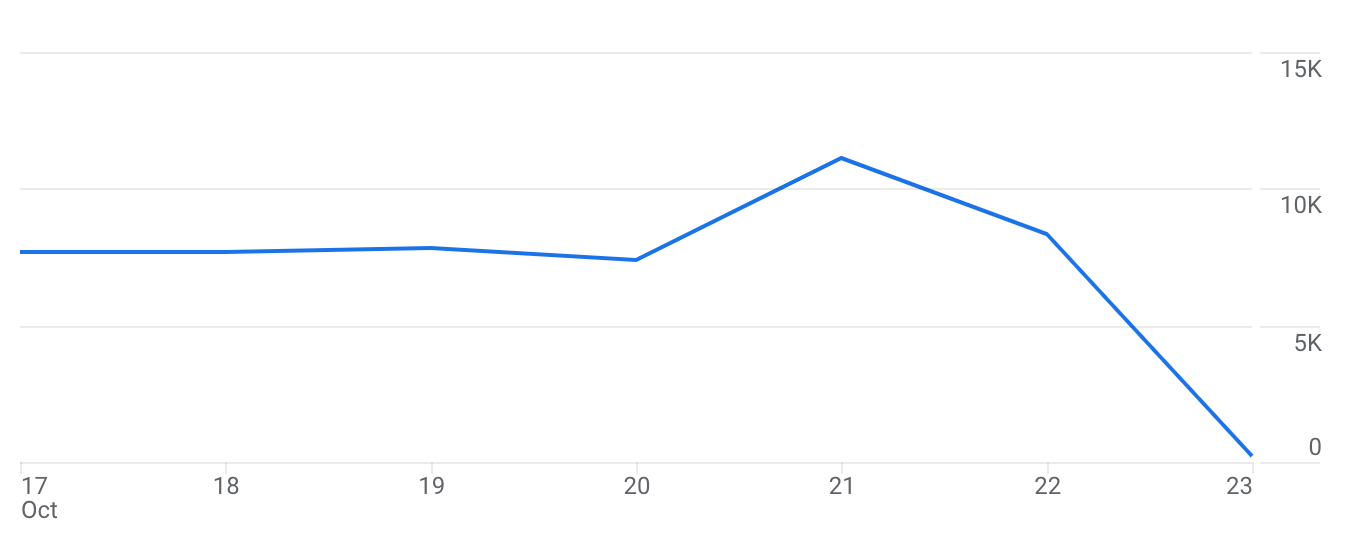
I haven’t found a reliable way around this (other than paying for 360), so this is just a PSA. Processing time is inconsistent too, especially when Google services are unstable (like they are now).
This table is from Google's official data freshness documentation:
| Interval | Typical processing time | Properties | Data limits per property | Query coverage |
|---|---|---|---|---|
| Realtime | Less than 1 minute | 360, Standard | None | Limited to a few dimensions and metrics |
| 360 intraday | About 1 hour | 360 | Premium Normal and Premium Large as defined here | All reports and API queries, except these |
| Standard intraday | 4-8 hours | Standard | Standard Normal | All reports and API queries, except these |
| Daily | 12 hours | 360, Standard | Standard, Premium Normal | All reports and API queries |
| Daily | 18 hours | 360, Standard | Premium Large | All reports and API queries |
| Daily | 24+ hours | 360, Standard | Premium XLarge | All reports and API queries |
Be wary of yesterday’s numbers in your reporting. If something seems off, you’ll need to wait a day or exclude the prior day and do trend analysis to see if anything jumps out.
For immediate peace of mind, use realtime reporting or Tag Assistant to do a quick check, making sure things look to be firing as they should. 🔧
Henry Ford’s “any color as long as it’s black” choice may have been too minimalist, but more, more, more isn’t always better.
Studies have found that there is a choice cliff where sales drop when too much choice is present.
Too many choices can lead to procrastination, dissatisfaction, and suboptimal decisions.
Reducing the number of choices you offer can also decrease your costs.
A good listen on how to think about the current landscape of AIs and LLMs.
Add some Douglas Rushkoff quotes for additional context:
AIs are probability engines.
If AIs are based on us (our writing, knowledge, etc.), the only way to raise better AIs is to be better ourselves.
Emotional labor has become a competitive advantage. Our commitment to showing up as a human, even (especially) when we don’t feel like it is precisely how we create value. And it’s this human work that helps us feel seen and valued as well.
-Seth
Why am I extra bullish on podcasts right now?
TV and film producers prepare for potential post-strike production logjam
Once the actors’ strike ends the shows and movies still need to be made and the backlog will be big.
Content owners (Disney, Nickelodeon, Dr. Seuss, PBS, etc.) have been turning to audio to fill the entertainment gap and ad dollars are pulling back from TV because of the lack of new content.
The longer it lasts the more likely habits are to change in a meaningful way towards channels producing new entertainment.
Shocks cause shifts.