

The post-cookie Chrome is just about ready, which means the officially death of third-party cookies is imminent.
Of course, many of Google’s planned replacements are still a bit controversial, so this should be fun for marketers.
There are concepts for everything, and I think it is important in any industry to go beyond those fixed concepts. The major companies often don’t want to go there, so I think that’s our role at Kitan Club.
-Daiki Furuya
The Procurement Spectrum
This episode of The Knowledge Project podcast with Ray Flemings starts off with a hell of a story that transitions into an excellent overview of the procurement difficulty spectrum.
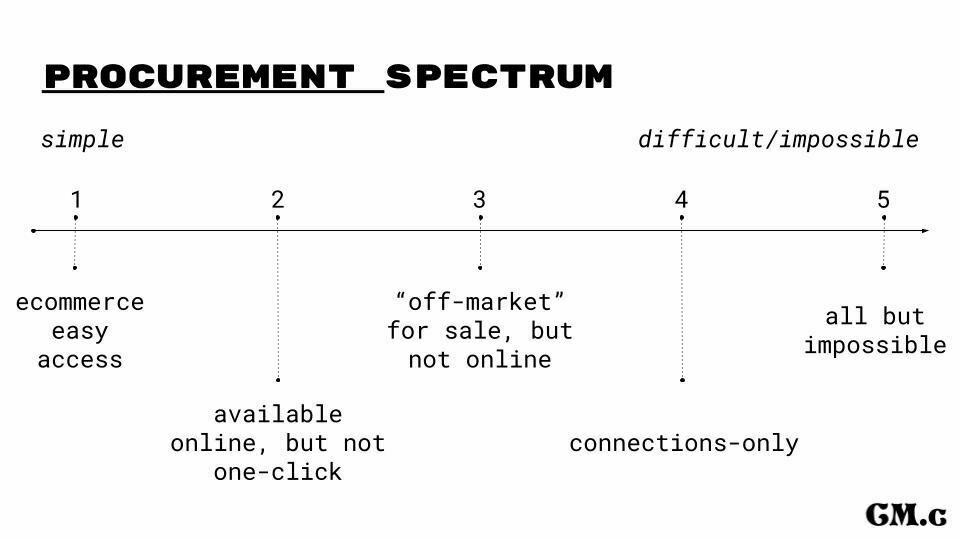
The easiest way to think about what we do is this five-step spectrum, where to the left, things are simple, and to the right, they’re difficult to impossible, so one, two, three, four, five. On the left, anything that you can purchase on a web browser. You want to rent a home to stay in when you go to LA. Well, there’s Airbnb for that. You want to buy a ticket to Coachella, go to Coachella dot com; you’ve got a VIP pass. Number two is hard. These are things where maybe they’re available online, but they’re still difficult for you to get your hands on. So these would be things like booking a private jet. You can book a private jet online, but it’s so confusing and so much brain damage from a booking. Most people use a broker or a travel person to do it. Number three, we call “off market.” So these are things that sellers want to sell, but they never list or make [them] available on a website—artist credentials to go see your favorite band and all sorts of other things that are never on public sale. Category four would be stuff that’s hard—walking on the red carpet at the Met Gala or being on stage with your favorite artist, et cetera, et cetera. Then the fifth category [has] the impossible requests, like the ventilator chase or all of these other sorts of wild and interesting things that we get called on to do.
It's useful to think about where your product, service, or experience falls on this spectrum.
Along with where your customers (and aspirational customers and those your customers aspire to be like) fall along this spectrum.
You may be an ecommerce store with a low-friction checkout, but your customers may be operating at level 4. How do you create a brand story and experience that lends a level 4 (or 5) sheen to your level 1 procurability?
It doesn't matter what your really are, it matters what they think you are.
Marketing Against The Grain on Sales vs. Marketing
Wrapping up the sales vs. marketing roadshow with one final podcast (maybe (for now)). This time it's Marketing Against The Grain. The spicy take from the show is above, but let's look at what else they got into.
Here are the quick hits:
- AI is a platform shift
- Software gets easier to create and therefore commoditized
- Marketing matters (see: Liquid Death)
- Marketers are creators, creators disrupt brand
- All creators are marketing first
- Marketing will take over more of the customer journey / experience (powered by AI)
- The marketers are the automators
Let's pull a few quotes (or paraphrases) to dive deeper on some of those bullet points.
About AI:
AI will lead to the ecommercization of most businesses.
The distinction between B2B and B2C will blur and disappear. It's about B2P now: Business to Purchaser.
About commodotization:
As commoditization increases (accelerated by AI), marketing becomes more important.
You differentiate on brand, message, and value messaging instead of core product.
Marketing will take over more of the customer experience.
On the creators bit:
The creator playbook is the future of marketing (they don’t have the same concerns as a public business and can have a schtick).
And, oh yeah, sales and marketing are the same thing:
The marketer doesn’t need to stop at ‘oh, I hand over the lead to sales.’ They can automate the sales outreach. Marketer goes all the way up now to transaction. But they don’t need to stop there. A lot of the support function* can be automated.
But how does this impact the org chart?
Marketing is owning all the one-to-many work. The other teams own specialized, human-work processes.
One functional group leads the one-to-many experiences. One group leads the one-to-one.
It's not sales or marketing. It's sales and marketing.
Consumers don't get to a point in their journey and have to make a choose-your-own-adventure decision between the two. Their journey should be seamless. Structure your processes accordingly.
* Everything is customer service. Starting with this core belief creates the best marketing.