

A slew of earnings reports last week from the consumer discretionary sector raised the specter of sapped spending as executives discussed the possibility of increasing prices on goods to offset the costs of tariffs on shipments from Canada, Mexico, and China.
Retail roulette continues
via The Daily Upside
Word of mouth is always the best marketing…but after your first impression doesn’t go as planned, it’s the only type of marketing that makes a difference.
So make it cool and less risky for your fans to re-tell their friends.
I love this ad
Not because it’s especially good or cool.
Because instead of rambling on about features or tech specs, it frames things in terms of the emotional benefit to the customer.
Shoppers don’t care about the technical stuff until they’re about to make the purchase.
The Anti-Instagramable Taco Shop
Grabbed tacos with some coworkers last week from a restaurant that opened in an old UPS Store space. Even if we hadn’t known (we only knew because one of the crew remembered it being there), it would have been obvious as soon as we walked in.
All the UPS Store fittings were still there—counter, table, shelves, carpet—with some thematic decorations and touches layered over the top.
This wasn’t a place to sit and eat, it was a grab-and-go counter. And it was delicious (bonus points for having beef tongue tacos, not often seen on menus around here).
They could have put money into renovations and appearance, or they could focus on the food—the actual product.
I’d go back, so I guess they focused on the right thing.
Plus, the absurdity of the interior makes it more likely that I’ll talk about it and remember it.
“Hey, let’s go get tacos at the old UPS Store.” 🌮
More findings from Podscribe’s recent podcast performance report:
- Ads bought per episode (“episodic”) outperform buying across shows (aka “run of network”)—more conversions on more efficient spend
- Host-read ads drive more purchases but cost effectiveness might be a wash
- Mid-roll ads are more efficient per impression, pre-roll are on a per dollar basis—and post-roll are trash
- Longer ads deliver better performance, especially on a per dollar basis
New study sheds light on the role of sound and music in gendered toy marketing
commercials aimed at boys, the soundtracks tended to be louder, more abrasive, and distorted, reinforcing notions of masculinity through harsher soundscapes. In contrast, ads targeting girls featured softer, more harmonious music, reinforcing traditional associations with femininity.
[music-primed gender schemas] merge aesthetic and gendered meanings, priming listeners to associate certain sounds with masculinity or femininity. In the context of advertising, this can reinforce narrow conceptions of gender roles, which, in turn, shape children’s perceptions of what is ‘appropriate’ for boys and girls
According to the first author, toy commercials can be described as “semiotic bombs,” packing multiple layers of meaning into short bursts of sound, imagery, and language.
Don’t just zig when your competitors zag, try zigging when your brain zags. Doing the opposite of what “feels right” or “normal” or “standard.”
Zig to your competitors’ zag and have much success.
contrarian investment funds far outperform their herd-fund rivals in several performance measurements, and that their managers have found ways to gather information that other managers haven’t figured out.
The study was specific to investment funds, but the thinking holds.
Do the same thing as everyone else and get worse results..
Herd behavior benefits the first movers.
People love free samples. Is the marketing opportunity of the future free tastes?
Novel technology intends to redefine the virtual reality experience by expanding to incorporate a new sensory connection: taste.
“The chemical dimension in the current VR and AR realm is relatively underrepresented, especially when we talk about olfaction and gustation. It’s a gap that needs to be filled and we’ve developed that with this next-generation system.”
Free smells too!
via ScienceDaily
Smaller is better. At least when it comes to podcasts for ad performance.
Smaller podcasts consistently are more efficient at driving visitors per impression
smaller podcasts are more effective per dollar spent
smaller shows may have more committed, niche audiences that are more connected to the host
Which makes sense, since podcasts are basically audio-first influencer channels. It’s about audience engagement, not size.
More nuggets:
- 16% of site visits occur within 24 hours of hearing an ad
- 40% within a week
- 80% within 23 days
The Content Quality Cliff
I like this Quality Cliff model from Animalz.
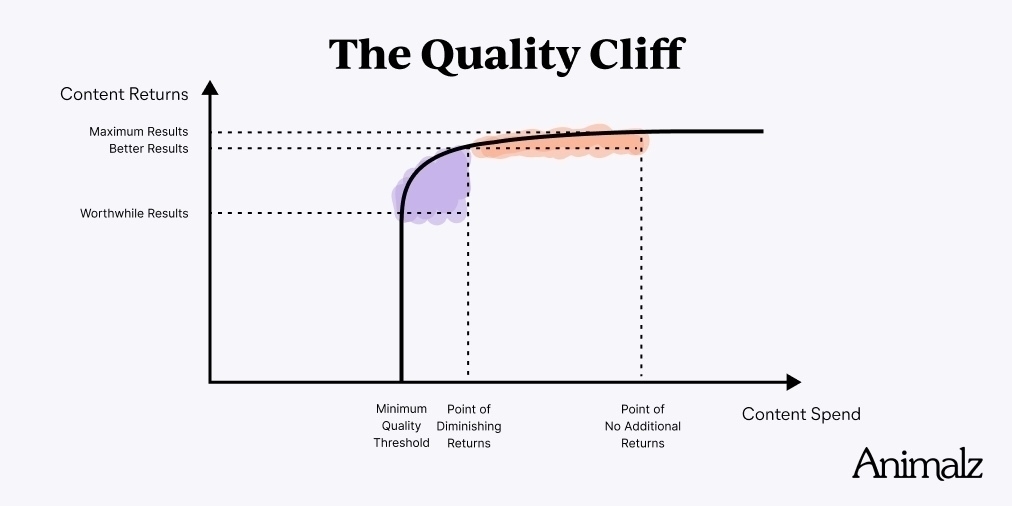
A baseline of quality is needed for any piece of content to “work.” But at some point you’re polishing for the sake of procrastination or perfection, not performance.
Of course, there is no universal benchmark or threshold.
Consistently undervaluing the need for quality risks dismal results; pursuing quality at all costs winds up expensive and over-engineered. You need to evaluate every topic and campaign on a case-by-case basis.
Just like Steve Pratt says about creative bravery:
It is relative to every brand. There’s no universal scale of creative bravery.
What’s creatively brave for you could be a way of thinking about it.
Most of it is thinking about who the end consumer of the content is—whether it’s a podcast or a video or an email newsletter—is this something that they’re actually going to look forward to and appreciate. Is this going to create value for them. Is this something that is coming from you but not about you.
What is a gift we can give that can only come from us that is intended and designed for the people you’re trying to reach?
Stated even clearer:
Is this brave enough to get into the attention fortress?
Using video as an example. There is a minimum viable quality if you want your video to “work.”
TikTok and the rise of “authentic content” has dropped this bar, but it still exists. Lighting, angle, story, and speed are probably the core 4 to hit the minimum.
- Can we see the subject of the video?
- Can we figure out what it is?
- Can we figure out why you made the video? What are you trying to tell us about the subject?
- Is it slow enough that we can keep up but fast enough that we don’t lose interest?
But there’s a lot of ground to cover between that minimum and the maximum of a Super Bowl commercial or branded blockbuster film.
The decision you need to make is: do you need a top 5 Super Bowl commercial this year? Or do you just need a short-form vertical video that will get people to pay attention and maybe engage a bit?
And be clear about why you need what you decide. Whether it’s vanity, cachet, or KPIs. (Or Deb in accounting.)
Minimum viable (for the performance you want) is usually the better choice than maximum available.
Be brave. Or be ignored.
Be weird.