

Work can only be universal if it is rooted in a part of its creator which is most privately and particularly himself.
-Tyrone Guthrie
Brands typically try to smooth out the edges—polish everything to a uniform shine. In the post-AI world, it’s the idiosyncrasies that will make for truly winning brands.
Mission, vision, values are pieces of paper that can change with a board meeting.
Personality is actually having something to say and a unique way of saying it. Something that is core to the brand itself and not a committee’s reaction to societal trends.
See: Liquid Death
Doing business on the internet is about convincing people you don’t know that you have something they need or want. Think of a brand as the bridge between the two.
-Jack Butcher
Brands bridge the identity narrative between business and customer.
Brands are bat signals.
Not logos.
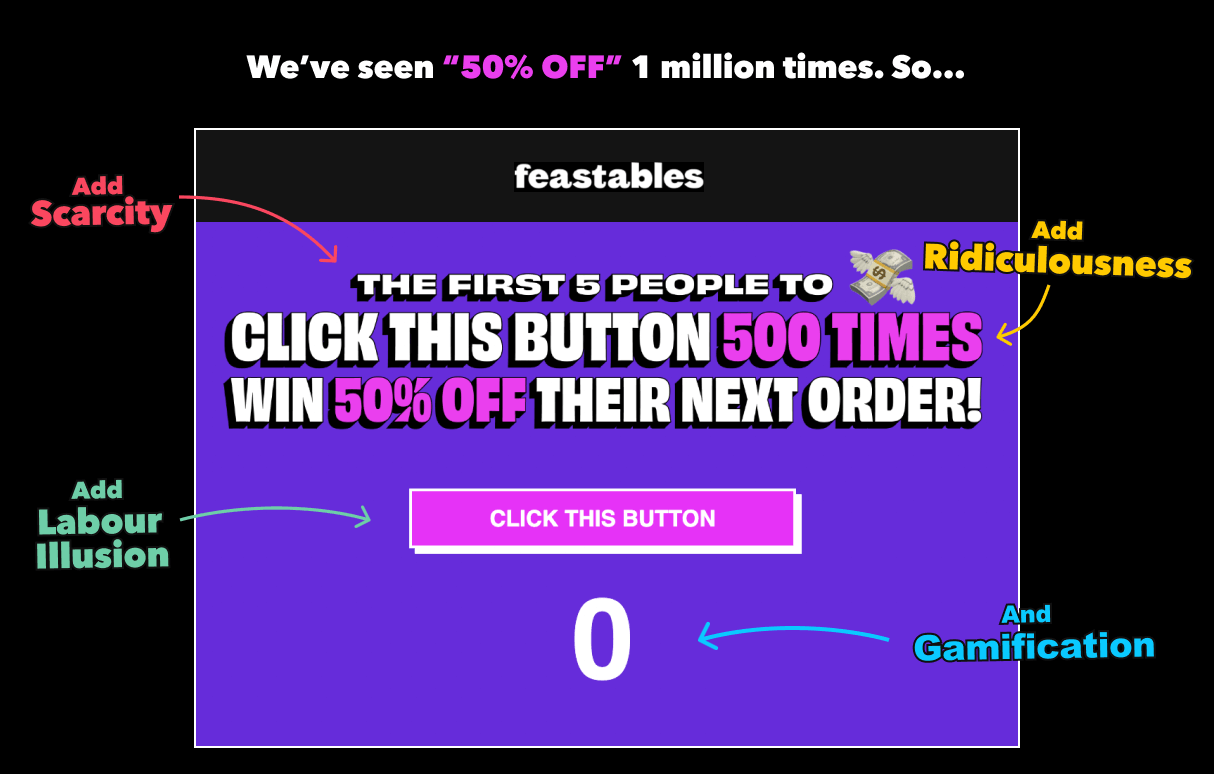
I love this. It’s ridiculous. And it works because it’s ridiculous.
It’s so over the top that it’s not a dark pattern or a trick.
It’s also a great way to figure out who your true fans are.
via Harry Dry
The best businesses understand and embed themselves into the lifestyles and self-conceptions of their customers.
When you sell a product, you’re not just selling a product, you’re affirming an identity.
-Greg Isenberg
Identity is a narrative.
The brand-customer relationship happens when the narrative the brand is telling dovetails with the narrative the customer is telling themselves.
This quote from The Daily Upside doesn’t surprise me:
Sales of new homes picked up considerably to end 2024. But sales of old homes are at their slowest pace since 1995.
A big part of the pandemic housing market insanity was older workers buying their forever homes. Locking up the existing inventory at that time and taking a big portion off the potentially liquid market for the near future.
Also, more evidence of The Great Splintering.
In the theatre the audience want to be surprised—but by things they expect.
-Tristan Bernard
And what is social media (and other digital outlets) these days if not a form of theatre?
People want to be surprised by your marketing, but not confused.
The comforting warmth of the familiar wrapped in a new package.
Of course, sometimes a big leap followed by consistency reframes the initial surprise as expectation.
I love a good hierarchy / process workflow for uncovering the core cause of ad performance swings, so this tweet on Google Ads is for me.
We divide Google Ads metrics into 4 levels:
Level 1: CPA, ROAS, Conversions
Level 2: CTR, CR, Clicks, Impressions, CPC
Level 3: Impression share, Quality score, Ad relevance, Landing page experience
Level 4: Keyword, ad copy, device, audience segment, geographic.
ID which level 1 metric is the problem and work down the list of related metrics in 2-4 to determine what you need to change.
In most cases, potential issues fall into 3 main areas:
- Account - ads, ad relevance, landing page.
- Market - competition, keywords, location.
- Website - user experience, mobile optimizations
For bonus points, set up automated alerts to react faster to performance drops.
No rate change from The Fed this month as the committee waits to see what exactly is going to happen with the economy, just like the rest of us.
They acknowledge “Inflation remains somewhat elevated” and probably want to see what form Trump’s Trade War takes.
Proof that the linear marketing funnel is a dinosaur
The average American spends over 3 hours per day on their phone during work. That’s 186 minutes broken down into:
- 46 minutes on social media
- 33 minutes texting or messaging
- 30 minutes listening to podcasts
- 27 minutes streaming video content
- 15 minutes playing mobile games
- 13 minutes shopping online
- 22 minutes on other non-work-related activities
Work-life balance is a work-life blur when it comes to media usage.