

Generative AI comes to Google Ads:
advertisers can generate all the assets they need for a campaign by simply providing the URL of a preferred landing page, rather than creating a range of text and image assets individually. From there, advertisers can view and edit AI-populated assets, including both stock and AI-generated images, with a guarantee that Google will never create two identical images, even when given the exact same prompt.
Platforms will increasingly give the levers advertisers are used to pulling to the robots.
We are all creative directors now.
I recently wrote that the current splintering of social media is
maybe time for the rebirth of blogging?
Search may be splintering too, but the current version is [good for blogging](Study: Blogs appear most often in top Google positions searchengineland.com/blogs-top…) too.
Blog posts are the most common content type found in the top 5 Google positions
Multiple CTR studies show most organic clicks go to the top 5 positions on Google Search (around 69% to 74%).
Google is going Apple and hiding IP addresses.
The feature is called IP Protection (formerly Gnatcatcher, which sounds cooler, tbh), and it will limit IP tracking by third parties.
This “could mean that the IP address is not the viable post-cookie alternative some thought it might be.”
I don’t know why it was ever considered a viable alternative in the current privacy environment. Part of the reason GA4 dropped IP addresses was to conform with privacy regulations.
3rd party IP access is going the way of 3rd party cookies, not replacing them.
Big G runs on ads and AI and is still working to combine those 2 to create the future of Google Search.
In its earnings call for the third quarter of 2023, Alphabet and Google CEO Sundar Pichai said that the company plans to experiment with a native ad format suitable for its Search Generative Experience (SGE) that is “customized to every step of the search journey.”
via TechCrunch
We might have reached peak vertical video:
Have consumers started to cool towards short-form video? That’s certainly one read from Google and Snap results.
If anything this serves as a good reminder to not go all in on one content format based on the platforms’ push du jour (just ask news publishers about social video). Different businesses do different forms of content better than others and different forms work better for different purposes.
Don’t give up on vertical video. But don’t go all in on it either.
Goblins of GA4: Data Lag
Despite solid realtime reporting, it can take up to 24 (and maybe even 48) hours for data to fully populate the reports throughout GA4.
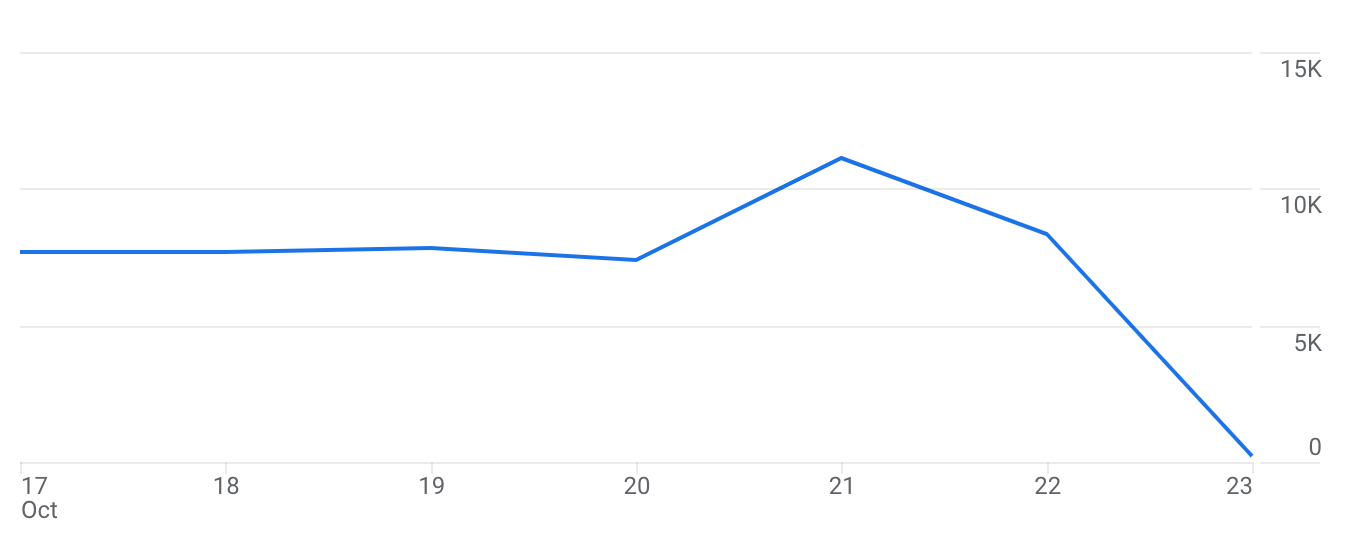
I haven’t found a reliable way around this (other than paying for 360), so this is just a PSA. Processing time is inconsistent too, especially when Google services are unstable (like they are now).
This table is from Google's official data freshness documentation:
| Interval | Typical processing time | Properties | Data limits per property | Query coverage |
|---|---|---|---|---|
| Realtime | Less than 1 minute | 360, Standard | None | Limited to a few dimensions and metrics |
| 360 intraday | About 1 hour | 360 | Premium Normal and Premium Large as defined here | All reports and API queries, except these |
| Standard intraday | 4-8 hours | Standard | Standard Normal | All reports and API queries, except these |
| Daily | 12 hours | 360, Standard | Standard, Premium Normal | All reports and API queries |
| Daily | 18 hours | 360, Standard | Premium Large | All reports and API queries |
| Daily | 24+ hours | 360, Standard | Premium XLarge | All reports and API queries |
Be wary of yesterday’s numbers in your reporting. If something seems off, you’ll need to wait a day or exclude the prior day and do trend analysis to see if anything jumps out.
For immediate peace of mind, use realtime reporting or Tag Assistant to do a quick check, making sure things look to be firing as they should. 🔧
Google is further signaling the decay of attribution modeling with the announcement:
First click, linear, time decay and position-based attribution models are going away
None of these were great. Data-driven replaced position-based and GA4’s shift to user (and event)-based measurement over session-based made first click redundant.
But I think this is an admission from Big G that (aside from last click) accurate attribution is hard to do in a post-cookie world, so it’s all about data modeling now.