

Update on the missing UTM data in GA4:
As of this morning I can see lower level parameters populating for yesterday (still no data from 11/30 - 12/5).
The key will be if this data is still there tomorrow (or even later today).
[Simone Weil] says to imagine a farmer that goes down to the farmer’s market. He’s gotta BUNCH of chickens. Look at all those chickens. And she says this FARMER…has a LEGAL RIGHT…to SELL his EGGS down at the farmers market for as much as he wants…he has the right to sell them for $20 a dozen if he wants to. He ALSO has the right to go out of business when no one wants to pay $20 for a dozen eggs.
Your customers don’t owe you their fandom. Or even their business.
An important thing for business leaders to hear (cough cough Elon cough)
GA4 Tip: Search Bar Filtering
This is either a nice feature I stumbled on today. Or a bug that will get "fixed" soon. Hard to tell with GA4*.
Easier Data Filtering in GA4
Now for the search bar trick part.
The search bar above the table filters the results (duh, Kyle).
But!
If you change the dimension you're displaying after you use search to filter, it will return only the dimensions that match that filter.
That sentence makes so sense, so let's use pictures.
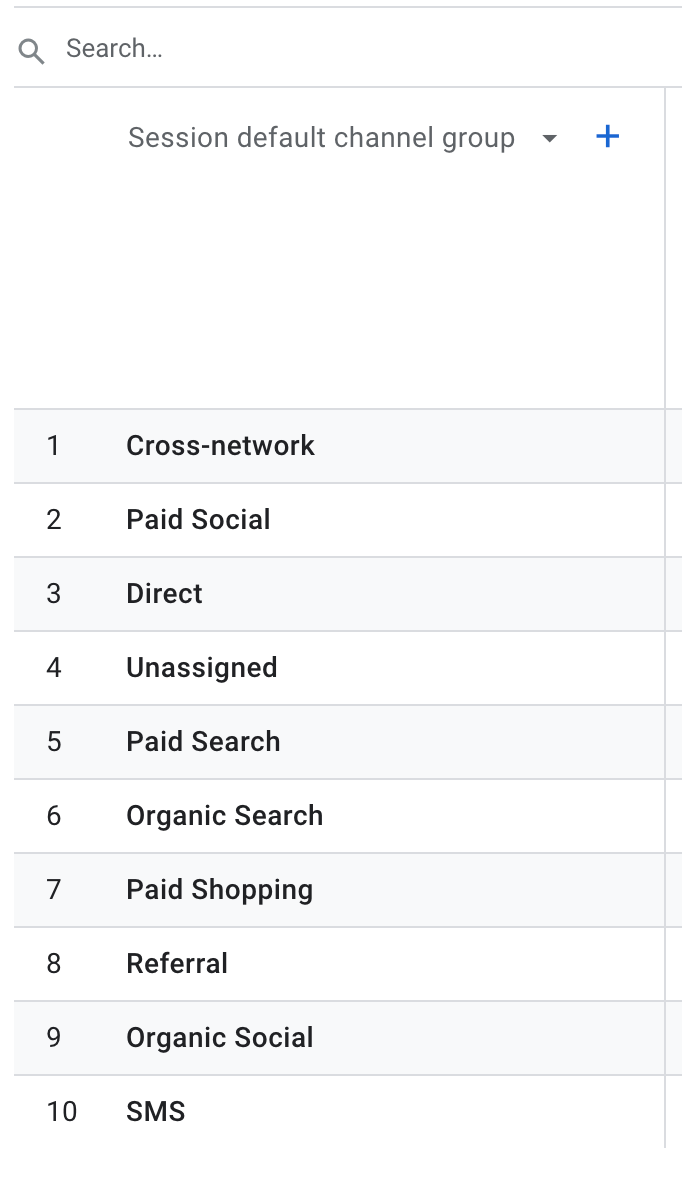
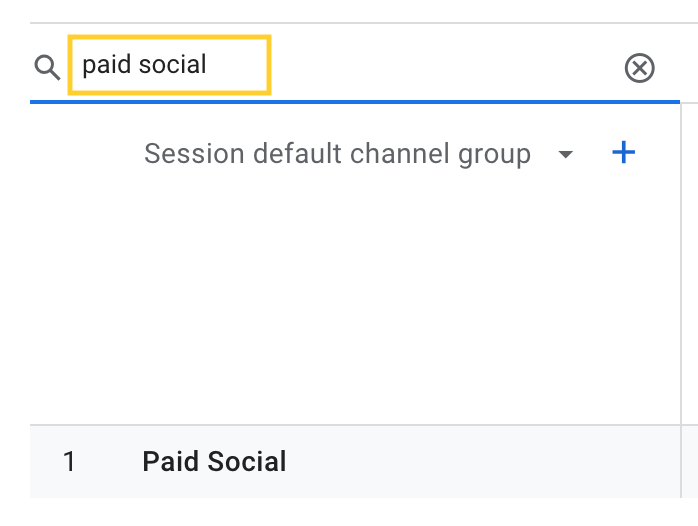

The final table shows us only the Session source / mediums that are present within the Paid Social default channel grouping.
We have Content Groups setup for a client and this filtering trick works the same way there. Letting you narrow to a specific content grouping and then look at page level detail for pages within the group.
How To Find Source / Medium Data in GA4
Not sure where to find your source / medium level data? I got you 👇
 Kyle Mensing
*Remember this...
GA4 is a young platform. Google bought the company they used as the foundation for Universal Analytics back in 2005, that's almost 20 years of development and user experience by the time it sunset.
Google Analytics 4 is built on a toolset that was mobile-only until a few years ago, only hitting Web+App beta in 2019.
You can't compare the two, they're at different life stages. Yes, it feels like GA4 is still in beta sometimes, but that also means new features and functions are being added regularly.
You can lament that it isn't like UA and you have to learn your analytics platform all over again. Or you can level up and future proof yourself.
🚨 GA4 Error Warning
Starting on (roughly) November 30, some UTM data has stopped populating in GA4.
I can’t see anything more granular than campaign level data from my UTM tags. A friend reports the same issue.
It appears the Google team is working on a fix.
Case Study: Sendero’s Sales Stampede
What if your limited edition drop was an offer and not a product?
Sendero ran an offer drop that turned into a consolation discount that flowed into Black Friday. Let's take a look.
First, priming the drop pump. (This email was forwarded by a friend, virality!)
Subject Line: 300 FREE HATS, It’s Coming.

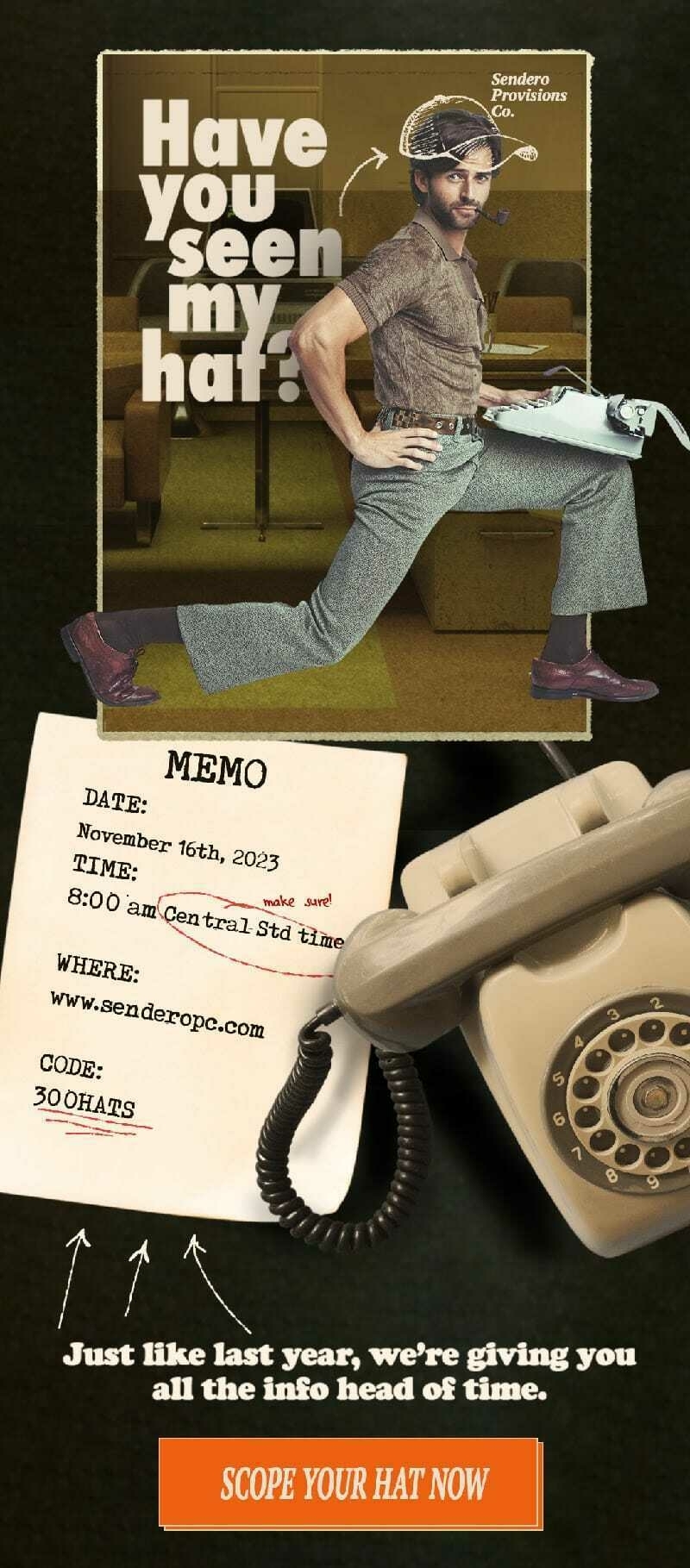
What I like about this email:
- Movement! The gif is eye-catching, highlights product, and slowly reveals the message. So much dopamine.
- Personality! This is true with everything Sendero puts out, they know their voice and they speak in it (and personality is part of building a cult brand).
- FOMO! Date, time (timezone math warning included), and code. Everything you need to put it on your calendar (free reminder marketing) and get hyped.
- Attachment! The CTA "Scope Your Hat Now" encourages you to start shopping, which means picturing yourself wearing the hat of your choice, which means getting attached to the idea of getting it. (Am I saying this from personal experience? Yes, yes I am.)
Everything is about getting you queued up to try to snag yo' hat, but in a way that feels like a friendly reminder vs. a pushy sales team trying to hit quota. (Can you have a quota when the thing is free?)
But did you get a free hat?
No!
I put my code in at 9:00 am eastern (8 central (I tried before but it wouldn't work)) and by the time I got to payment all 300 hats were claimed (thanks, in part, to forgetting I wasn't signed in to my first payment method attempt and having to go back).
I messaged my friend that I missed out at 9:01. Not even Taylor Swift sold out that fast.
BUT!
They had a consolation prize ready to go. There was a message (don't remember exactly where, I was too dejected to think to screenshot it too) that said the 300 free hats were gone, but you could use code 20HATS to get $20 hats (a 37.5% discount (and yes, I got myself a $20 hat—one I had saved thanks to an Instagram ad weeks before)).
AND!
If you were a new addition to the mailing list thanks to this offer drop, you got a 15% discount email too.
Then a reminder (if you hadn't used it) that it was expiring soon.
And then Thanksgiving and Black Friday.
SO!
Without needing to run a product drop (though there were new releases around this time (and pre-orders)), Sendero was able to use an offer to:
- Flood the site at one specific time
- Giveaway 300 free hats in a minute
- Turn the losers (a.k.a. me) into potential paying customers with a consolation code
- Probably get a bunch of new email subscribers that would be enticed to shop more with another discount code
- That would probably expire just in time for their Black Friday sale (up to 60% off) to start
Sendero captured attention for nearly the entire month of November.
With one promo code offer drop.
Speaking of that Black Friday sale...
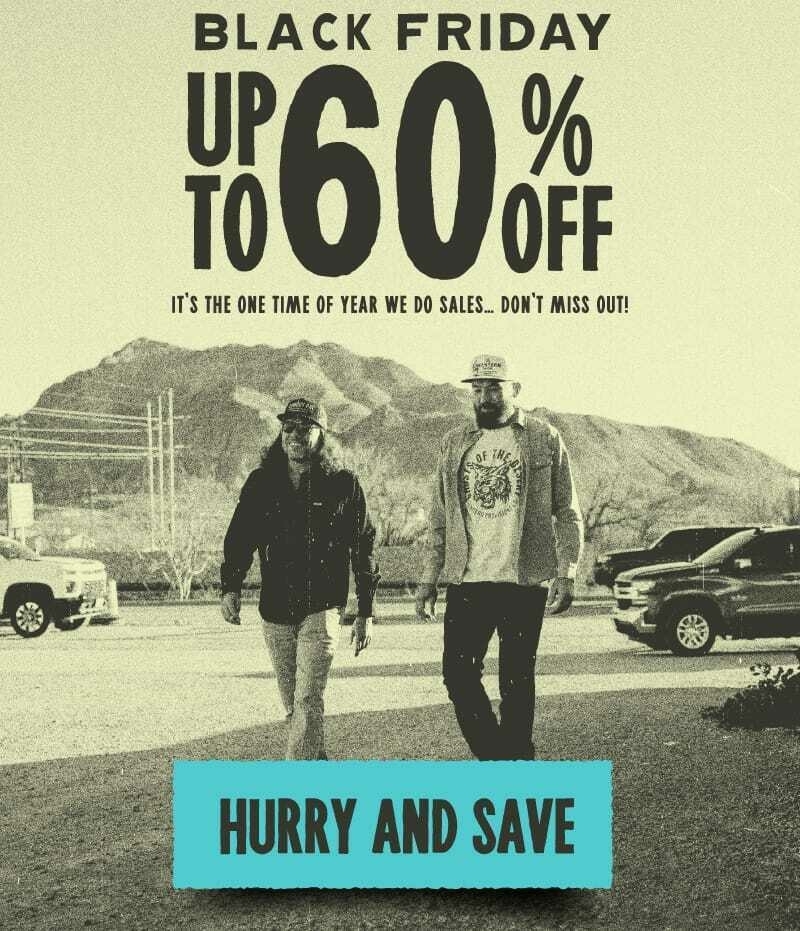
Notice what the fine print says?
It's the one time of year we do sales... don't miss out!
I talked about this with Sephora on the linkblog. They only do 2 sales a year, and they are highly anticipated events with brand fans (one is conveniently timed before the holiday shopping season really pops off too).
Some brands (JCPenney) are always running sales, and this can devalue brand perception. Why would someone buy when a sale isn't running if they expect you'll have one in a matter of days?
Most demography is made up nonsense that isn’t true.
I think it’s often done to sell consulting services and to make marketing seem like they’re creating generations. The truth is I don’t really believe—with one exception that I’ll come back to—there’s much difference between Gen X & Gen Y. Between the Millennials & Gen Y.
Being young has different meaning in one context, which is the pre- and post-digital era [BiP (before iPhone) and AiP (after iPhone)]. That’s the only demarcation that’s real.
More thoughts related to my previous post:
Aim to create moments of delight for everyone involved in crafting the story of your brand, customers and team members alike.
Brands are built on relationships. And relationships are built on attention. Giving and receiving. Pay attention to your customers.
More from how “To Make Your Business Stand Out This Christmas”; or, how to do marketing any time of year:
If your employees create a welcoming and warm atmosphere, it can make your business stand out from your rivals. This means you must invest in your people and ensure they are happy and motivated, even at this most stressful time of year in retail.
Make work fun for them
It’s about experience—before, during, and after purchase.
Every touchpoint with your brand writes another line in your brand’s narrative with that customer. And many of those touchpoints are facilitated by a team member.
How “to make your business stand out this Christmas”; or, (for this part) how to market your business any time of year:
Part of the battle to make your business stand out happens before the customer arrives in town or begins browsing online. If you can capture the attention of your target audience in advance, they are more likely to keep an eye out for your brand.
speak to the people most likely to buy from you. Target them with content that will entertain them, touch their emotions, solve their problems or add value to their decision making.
People don’t know about you. Until they do.
Search is splintering, social media is changing, and AI is here, which means the playbook needs to be updated.
For us who have built content and SEO engines in the past, we have to start to build engagement engines.
We have to move from an era where we did SEO-led growth and information-led growth, to engagement-led growth, personality-led growth.
It’s about creating engaging media as more channels are creator-focused over brand-focused.