

🚨Meta Meltdown: Check Your Budgets
You've probably heard by now, but a Meta bug decided budgets are for chumps over the weekend and went all in like a drunk kid in Vegas.
Per Social Media Today:
Some ad buyers reported CPMs up 200%-500% versus the previous day, while all ad performance metrics were seemingly affected. Other advertisers also reported their ad sets well exceeding their daily set budgets, with no way to limit the damage.
Details starting to emerge.
— Taylor Holiday (@TaylorHoliday) April 23, 2023
Here’s what we know.
- Issue began at 1AM PT
- Happened on FB more than Insta
- Meta has stopped serving audience network as a result (possibly the source of the issue)
- Campaign optimizations including offsite conversions, mobile app…
Was my Ad Account part of the overspend from Meta? How do I Find out?
— Grayson Lancer Cross | (Snack Sized) (@GraysonCross_) April 23, 2023
Where do I see breakdown by hour. Look below! pic.twitter.com/kFOVc6WWAK
It's too late to do much about it now, but if you can find a Meta rep you can request some credits to make up for it.
Meta Goes Twitter, A TikTok Guide, Google's Woes, & The Post-AI Browser
Metadon
Details about Meta’s “Twitter clone” are starting to leak.
Why the quotes? Because it feels more like Mastodon. 500 character limit, decentralized (or whatever that means in Meta-speak), and using your Instagram credentials for your account info (essentially choosing Insta as your Mastodon server).
Here’s why this is really interesting:
With more discussion shifting to messaging chats, as opposed to people posting in public feeds, Channels is designed to lean into this, providing a more private, intimate discussion interface for creators and their fans.
Barcelona sounds similar, though in a dedicated app, with users able to follow others and stay on top of their text updates.
The platforms venture further into the dark forests.
Stop, Collaborate, & Influence
TikTok has released a guide to running a successful creator campaign on the platform.
It boils down to being authentic yet on trend and connecting with the right subculture.
And remember:
Consumer attitudes toward influencers are changing, but not necessarily for the worse. Audiences are becoming more sophisticated and taking an active role in their relationships with influencers. Marketers who listen to consumer perspectives, choose the right influencers and stay flexible in the face of changing tastes will be set up for success.
Google Goes For Two
Big G’s ad revenue has dropped for the second straight quarter. But the bigger story is that Google is on the defensive for the first time in a long time following Microsoft’s BingGPT sucker punch.
OperAI
Opera has released an early preview of what the future of browsers could look like in an AI-powered world. Mostly a blank canvas for future developments, current features include: chatbot integrations and automatic tab grouping.
TikTok is Tops, Acura Goes Anime (Again), & A Pinterest-Shaped Opportunity (+ IKEA)
The Clock Keeps Ticking
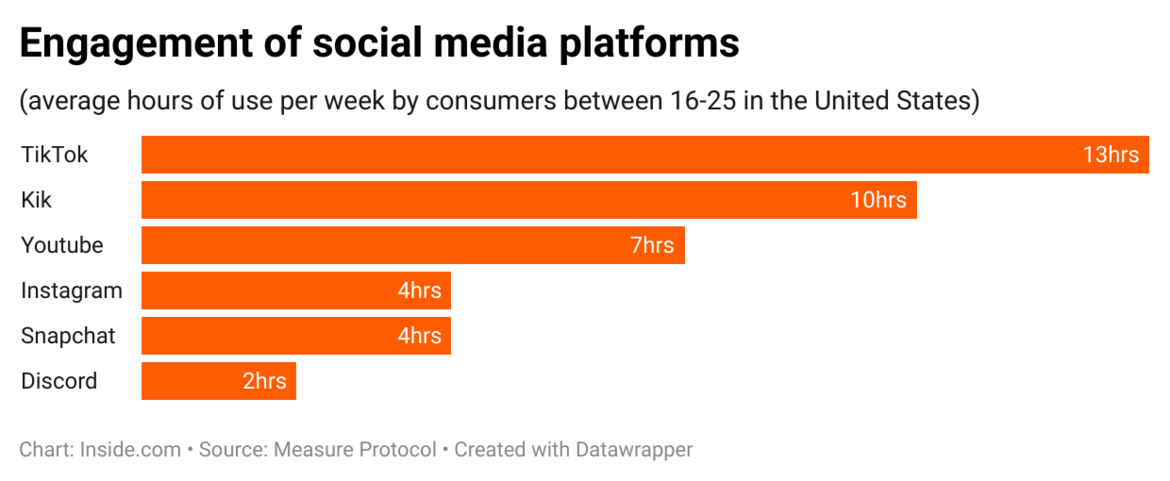
TikTok may be getting headlines for all the wrong reasons, but it seems to be proving the adage “no press is bad press.” The youths love their TikToks.
And yeah, it’s also a search engine now:
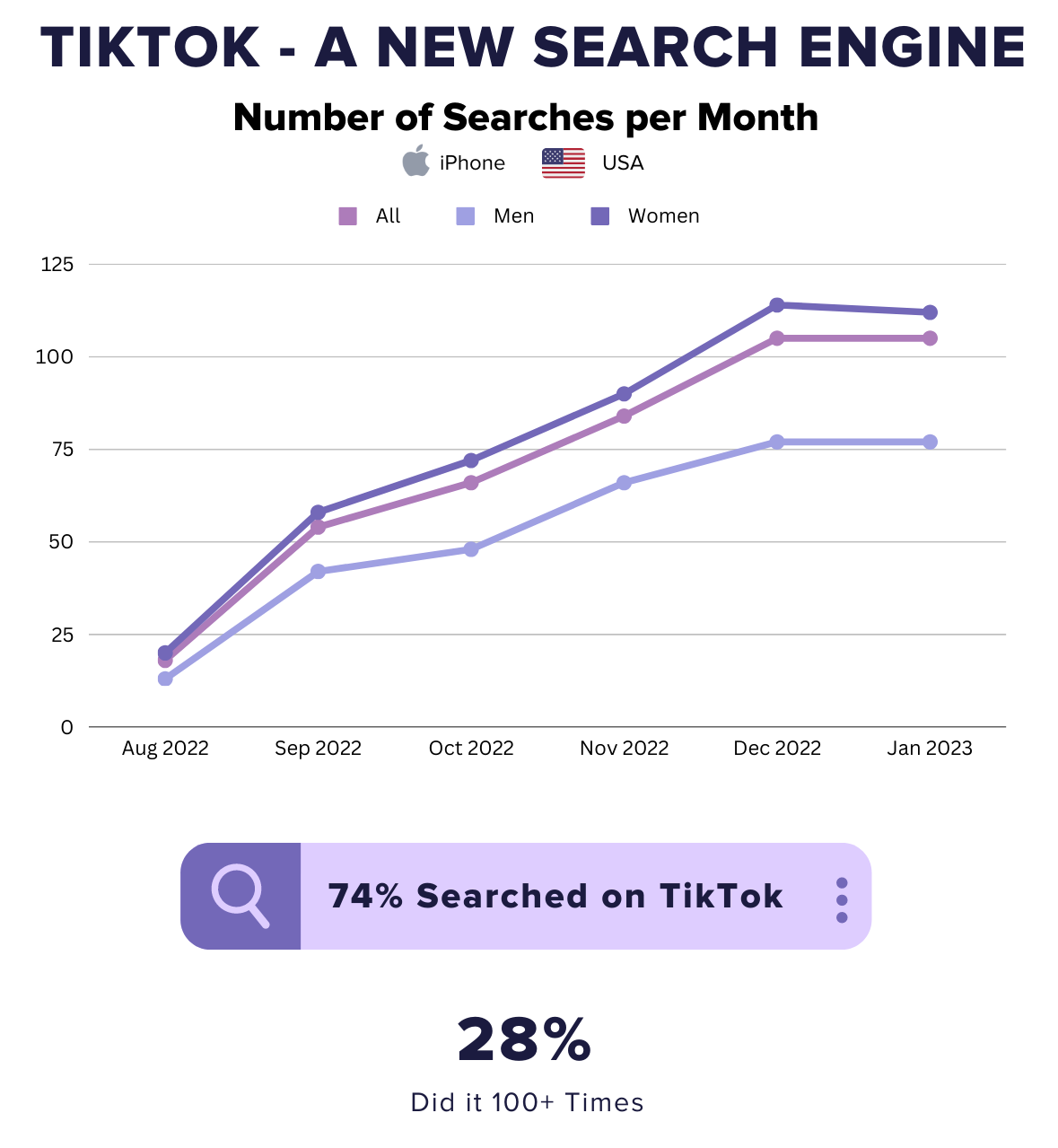
The splintering continues.
Now THAT’S What I Call Content Marketing
Acura released a (super) short anime series that racked up 275 million views. Now season 2 has dropped.
How short? 4 episodes clocking in at 60 seconds each.
Why it works: anime is popular but is (likely) largely ignored by most major brands. Cars and anime both have specific fandoms that can be reached via niche platforms, which means higher success metrics than general ones.
This is about building brand equity over the long haul. Creating an experience consumers want to engage with in a language that makes them feel part of an in-crowd is a solid formula for brand affinity down the road.
Opportunity Opens A Pinterest-Shaped Door?
Pinterest budgets are being sacrificed at the altar of performance metrics. As brands shift their focus to the bottom of the funnel, the inspiration app is paying the price. Which of course means you could benefit as auction competition lessens.
But…
Investing in brand is one of the best things you can do during a recession. As long as you can keep the lights on, brand marketing can help grow audience and mindshare for less as competitors focus solely on converting existing eyeballs.
Speaking of zigging while others zag:
While many major retailers are tightening their belts, IKEA is going all in. Everyone’s favorite (or least favorite) purveyor of meatballs and flat pack is investing $2.2B in US expansion over the next 3 years. This is apparently how much it costs to open 8 big stores, 9 smaller concepts, and employ 2,000 more people.
🗞️ Herding Headlines 04.03.23
Engage-a-thon 2023
The recent trend for social/content platforms has been expansion; free money fueled growth mode. But the Great Tech Reckoning of 2022 has reversed that.
The clearest example is Meta. A long, long time ago, Zuck split out Messenger from Facebook in an effort to capture more real estate on users’ screens (I think, the reasoning is hazy now and never made much sense to me). But now it’s getting rolled back in. More signals in one platform and less incentive to go back to the home screen and get distracted by another colorful digital dopamine drug app.
So consolidate and complement.
LinkedIn, social’s surprise Hansel, is continuing its run of feature additions geared at enticing users to spend more time on-platform. The newest push is (drum roll…) TikTok’s For You algorithm (algorithmically suggested content)! Which makes sense since the overlap of the Venn diagram of your connections and content related to your interests is almost certainly much smaller than it could be (at least that’s the case for me, so many bankers from a past career life).
Elsewhere, Spotify is shutting down its Clubhouse clone.
The company says it will continue to explore live features on its main platform.
There’s no time to try spinning up a new revenue stream generator for these companies. It’s time to try turning the money dial up to 11.
The plan for 2023: more eyes for more time in the flagship app.
Of course, ByteDance is (once again) zagging while the others zig and pushing to make Lemon8 happen. The grand ban plan b.
That Ban Plan
Congresscritters aren’t the only ones fine with banning TikTok. Survey says half of Americans are cool with it.
Unsurprisingly, the older you are the better you think the ban idea is. Same goes the more conservative you are. Ditto for knowing about the China ties and not using the app.
The Cookie Continues to Crumble
Publishers and ad tech tools are facing off once again. This time it’s all about context.
As contextual advertising continues to take the post-cookie lead, publishers are positioning themselves as custodians of attractive data. And ad tech tools are scraping the content to build their own context buckets.
Super blood moons, Mercury in retrograde, and scraping being at the heart of a digital content ownership issue, some things are like clockwork.
Retail.Tea.Leaves.04.01.23
Rethinking Returns
Amazon is testing a new feature in an effort to cut down a returns: adding a ‘frequently returned’ label to products that are just that.
And The Everything Store isn’t the only retailer trying to find a solution to the returns problem. But shoppers aren’t here for it. The numbers aren’t great for any brand trying to keep shoppers loyal or tout sustainability:
- 34% of Americans have dropped a brand for introducing paid returns
- 40% for shortening return windows
- 22% say return charges are totes unfair
- 18% just return unwanted items to the trash
So now brands are scrambling for other ways to mitigate the problem.
Livestream? More like Deadstream
From a Wired piece on livestream shopping in the US:
- “I haven’t seen one success case,” says Marina Jiang, an expert in cross-border ecommerce and founder of The Unoeuf Creative Consulting, a social marketing agency. “If there is one proof of concept in the United States, I would be willing to try it myself.”
See.99
Using the 99 price trick in your next sale? Maximize its effectiveness by displaying the original price along with the discount, it’ll make the savings seem larger. Or avoid the tactic all together if your product involves multiple pieces with individual pricing or if you sell high quality impulse buys and little luxuries.
Riches In The Niches
Wanting to start your own ecomm business to test pricing hacks on? Oberlo has 7 niches for you to consider for your fledgling shop:
- Home office equipment
- Eco-friendly products
- Home workout & fitness equipment (noticing a trend? Pandemic shifted behavior isn’t shifting all the way back)
- Recommerce (noticing a trend? People want to feel like they’re doing good for the planet (unless you’re charging for returns of course))
- Pet products
- Home decor (the housing market is likely to make people focus on feathering their nest instead of flying the coop)
- Menswear (men need clothes too!)
Pay Up; Or, You Know, Soon-ish
Apple Pay Later has finally arrived.
🗞️ Links & Thinks 3.31.23
Animal Spirits in Ad Markets
As has been discussed in this space previously, ad spending is cooling off as brands brace for a recession. Which could cause the recession they are bracing for?
Ad spending historically has lagged macroeconomic performance, meaning pullbacks weren’t as apparent until contractions had already occurred. That’s changed as the media buying window has shortened, making ad spending potentially more of a “leading indicator” of where the economy is heading, S&P Global Ratings argues
But some good(ish) news:
The research upheld that a recession is likely to take shape in the months ahead but will be “shallower” than previously thought.
Steal These Ideas
Elevar (a great Shopify app) shared a solid framework for conversion rate optimization in its recent email
- Identify the biggest drop in your shopping behavior funnel
- Find user actions that convert highly but happen infrequently
- Hypothesize and experiment
- Profit?
Wondering what ads your competitors are running on Google? Soon you may be able to take a peek thanks to the Ads Transparency Center. It doesn’t appear to be live, despite what Big G suggests, but this could be really useful.
Figuring out how much an influencer partnership is worth can be tricky but the new trend toward pay-for-performance could help (just don’t forget the value of branding).
Pay per performance is gaining traction among marketers as the second-most common form of payment used by 56% of marketers. This approach compensates influencers using performance-based metrics, such as sales, clicks, and impressions.
More Ads in More Places
Microsoft’s Bing chatbot is getting more ads / The AI-powered chatbot will start to show more ads — though exactly what those ads look like isn’t final just yet. (Sounds chaotic so far, in the typical new ad platform way, but it’s plenty intriguing.)
“This is how it’s always been done” is an instant red flag for me, so this quote from a piece on ads in audiobooks doesn’t hold much water in my opinion:
“It’s a premium, ad-free, transactional environment, full stop, and so I don’t really see the wisdom of changing that into an ad-supported [space] when there’s already a robust ad-supported ecosystem for audio, millions and millions and millions of people understand that audiobooks are a paid product, and podcasts are ad-supported, so it seems like a very expensive proposition to retrain people.”
rant mode: engaged
Millions and millions and millions of people also understood that you paid a cable provider to pipe a whole bunch of channels into your house instead of paying a channel directly, we all know how that worked out.
Ad supported tiers of other media types are also gaining tractions. You can stare in your rear view and hope the road ahead doesn’t have any curves, or you can be ready to adapt.
Everyone Hates Big Tech
There’s a “new” bill in Congress that essentially caps digital ad transactions at $20B, if a platform goes over that it has to start selling off parts to get back under. It would also prevent these large players from “owning more than one part of the digital ad ecosystem.” I understand what they’re going for with this, but it has unintended consequences written all over it.
Speaking of unintended consequences, turns out the legislation that would allow Joey White House to ban TikTok is a towering stack of them.
The RESTRICT Act contains “insanely broad” language and could lead to other apps or communications services with connections to foreign countries being banned in the U.S.
The bill could have implications not just for social networks, but potentially security tools such as virtual private networks (VPNs) that consumers use to encrypt and route their traffic.
Arkansas sues TikTok, ByteDance and Meta over mental health claims
Meta Is…
Launching "a new set of inventory filters for Facebook and Instagram Feeds, which will provide a simple way for brands to avoid unwanted association with potentially offensive, or otherwise undesirable content.”
“Planning to let European users of Facebook and Instagram opt out of certain highly personalized ads as part of plans to limit the impact of a European Union privacy order”
About Curious Kyle
Who the hell is this guy?
Hi! I'm Kyle.

I'm a strategist and tech nerd at Blue Ion, a badass full-service marketing and creative agency. I started this site to stop clogging chat channels with the news and insights I thought the rest of the team might want to know.
Also, I'm a human. Promise.
Checking In On Netflix's Ad Tier
The Netflix ad tier has hit the 1 million user mark. Which means it won’t have to refund advertisers anymore.
I’m interested how the numbers are working out for them. The ad tier is $3 cheaper per month than the ad-free basic plan. Netflix wanted CPMs in the neighborhood of $60-$65. Reports are that they’ve been a bit lower. But even at a $35 CPM, it’s forecast The ‘Flix could hit a $9.45 average revenue per user (ARPU) per month.
Making money!
But wait, they have to be paying Microsoft something to provide and maintain the infrastructure powering those sweet ad dollars. I don’t know what that agreement is, but it’s cutting into that $6.45 of monthly revenue differential.
If Netflix goes the roll-your-own route to replace the Microsoft stack, I wonder how long the ad-free basic tier will last.
It has to be looking at Disney’s success raising the price to avoid ads with envy. Same $3 difference, 94% of subscribers ponied up. (Expect that price insensitivity to be tested again.)
There is also the aggregation theory angle at play.
Netflix rose to prominence on a deep catalog of OPC (other people's content). That moat is gone. It's far from the only streaming service in town these days.
What happens when companies like Apple, Amazon, and Google start dumping billions of dollars into content production for their competing platforms? Those companies don't need to monetize that content directly, it's just a sweetener for joining (and staying in) their respective ecosystems.
Reed Hastings ('Flix cofounder) has one of my favorite views on content competition:
It’s 8:00 in the evening, you’re next to your TV–which remote control do you pick up: PlayStation remote? TV remote? Or do you turn Netflix on?
Sometimes employees at Netflix think, ‘Oh my god, we’re competing with FX, HBO, or Amazon, but think about if you didn’t watch Netflix last night: What did you do? There’s such a broad range of things that you did to relax and unwind, hang out, and connect–and we compete with all of that.
That's pretty clear-eyed. It also means the rise of TikTok and YouTube is just as panic-inducing for them as for Meta.
But for now the focus is on making enough money to stay relevant, otherwise the rest of those concerns are irrelevant.
After a rocky start, the new ad tier could be the money printing machine The 'Flix has been looking for. At least for as long as the current economic uncertainty sticks around.
❤️🔥 Make Your Brand A Cult
If there were a year to transform your brand into a cult brand, 2023 would be it.
If you want a brand like Death Wish Coffee, Patagonia, or The Liver King (don't be like The Liver King), then you're looking for this:
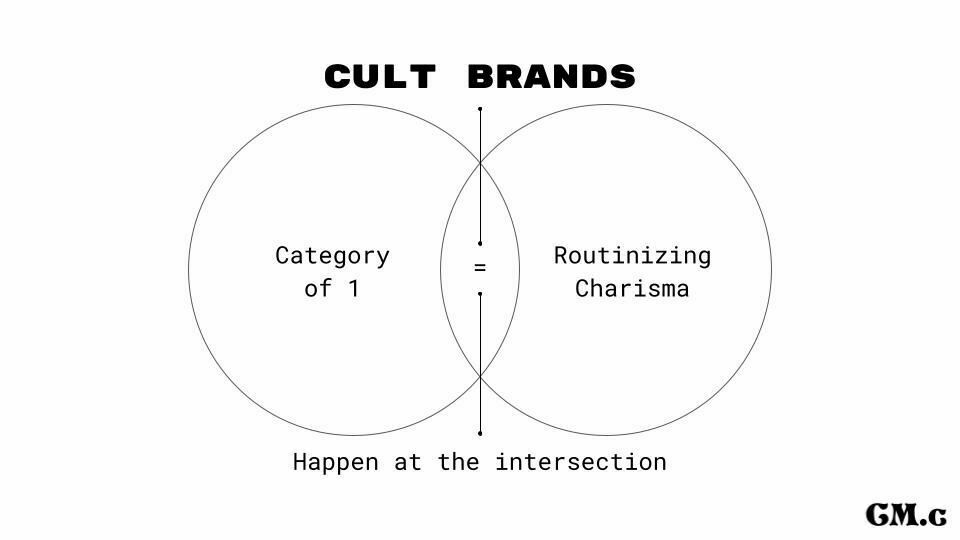
But how do you get there?
Here’s a rough guide created by combining these 3 episodes of the Marketing Against The Grain podcast:
- How To Start A Cult Brand | Lessons From Peloton, Nike, and CrossFit
- How Liver King Fooled The World With Great Marketing
- Use This Marketing Framework To Build A Cult Brand
Cults 101
Let's start with real cults, the kinds your parents warn you about and every procedural show needs at least one episode about.
Why do people join cults? (And what brands might match up?)
- Offering a solution to societal problems (Patagonia, health brands)
- Gain a sense of belonging (Peloton, fitness brands)
- Low self-esteem (fashion brands (Chanel, Gucci, etc.))
- Seeking purpose (Nike)
A few more quick nuggets to keep in mind:
- Cults are based around a charismatic leader that uses “routinization of charisma”
- People join cults to discover their individuality and stay for the sense of belonging—come for “you,” stay for “us”
- Word of mouth is the most successful method for generating new members
- Successful cult brands become the status quo
So, to apply that to brands:
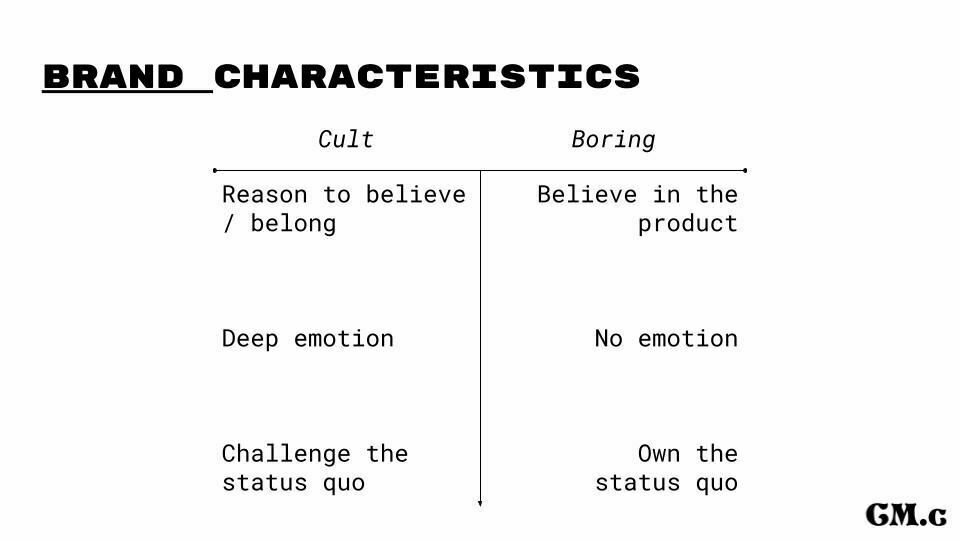
Let's get culting!
But first...
Be Marketing-Minded
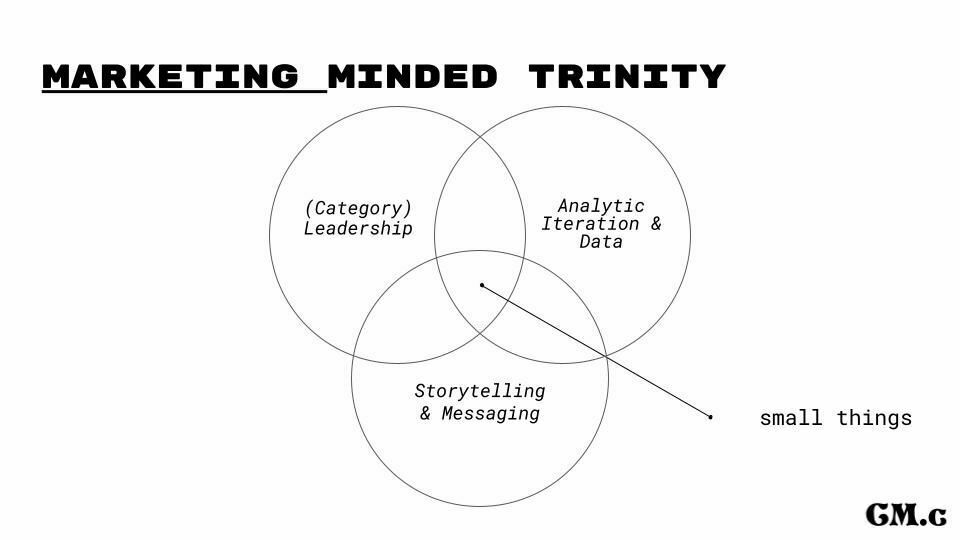
There are 3 general focal points for marketing people:
- Leadership (of a category or market, etc.)
- Analytic Iteration & Data
- Storytelling & Messaging
The key is to be at the intersection of all 3. And doing that means focusing on a lot of little things.
Here’s an example, where the marketing-minded person will put out something “on trend, relevant, and super cool.”
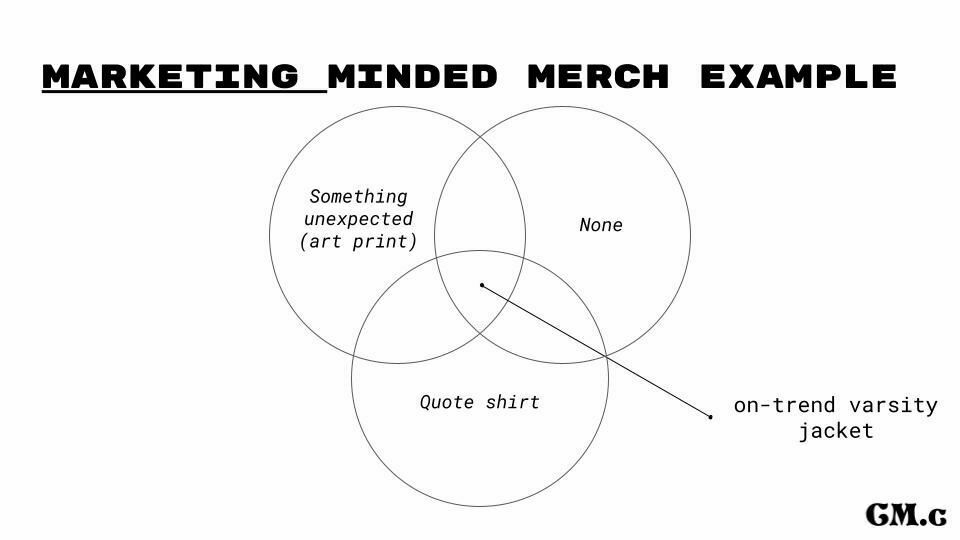
The goal is to operate from that central point and make it part of your brand's DNA.
Be A Category of 1
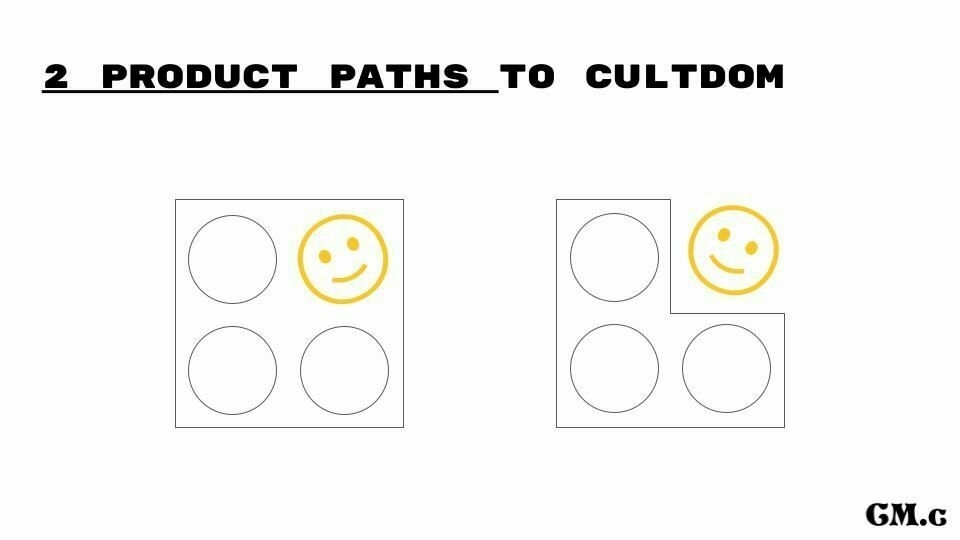
To cult your brand, you need to redefine the category and/or differentiate the product.
If you can’t create a new category—or if you have a product that is “nothing” (NFTs, anyone?)— you need to create a truly unique experience that makes it seem as if you are in a class of your own. You can’t just take something that exists and make it slightly cooler, you need an experience. (According to Todd McFarlane, adding 3% sexy gets you over the tipping point into something new.)
Be Charismatic
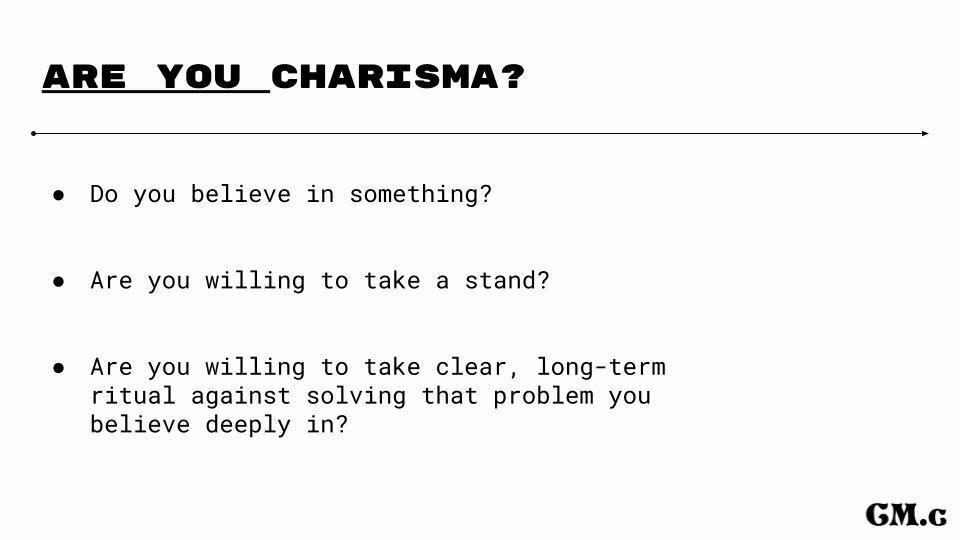
How do you do that “routinization of charisma” thing?
Organized religions have regular services. Crossfit has a daily workout.
This ritual is a critical part of culting your brand. It also serves as a word-of-mouth generator since fans will talk about it.
Put It Together
(Read that again, even if you aren’t trying to cult your brand)
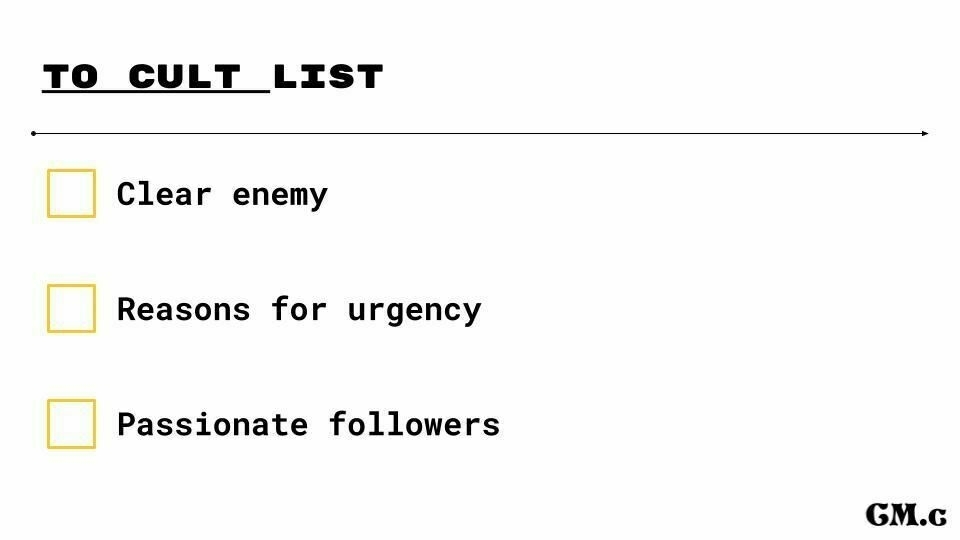
If you want to go the extra mile, you need to identify a clear enemy for your brand to stand against.
At its core this will be the status quo, but you can get more explicit with it (like Pepsi vs. Coke).
Create urgency with clear reasons why this is important to do now.
It wouldn’t be a terrible idea to reference that list of 4 reasons why people join cults and see what you can align with. This is where the charismatic ritual comes in.
Now the easy part, cultivate a group of passionate followers that are rabid about your brand and help spread the word.
This is where the rubber meets the road. Everything before this was theory, this is where you have to turn your dreams into reality.
While not covered in these episodes, I would recommend picking one—or maybe a small handful—of channels to focus on to build your fanbase. Pick the medium that feels most natural and manageable, then find the channels that match up, and then get to work making and shipping.
Wash. Rinse. Repeat. Repeat. Repeat.
Build Your Pyramid
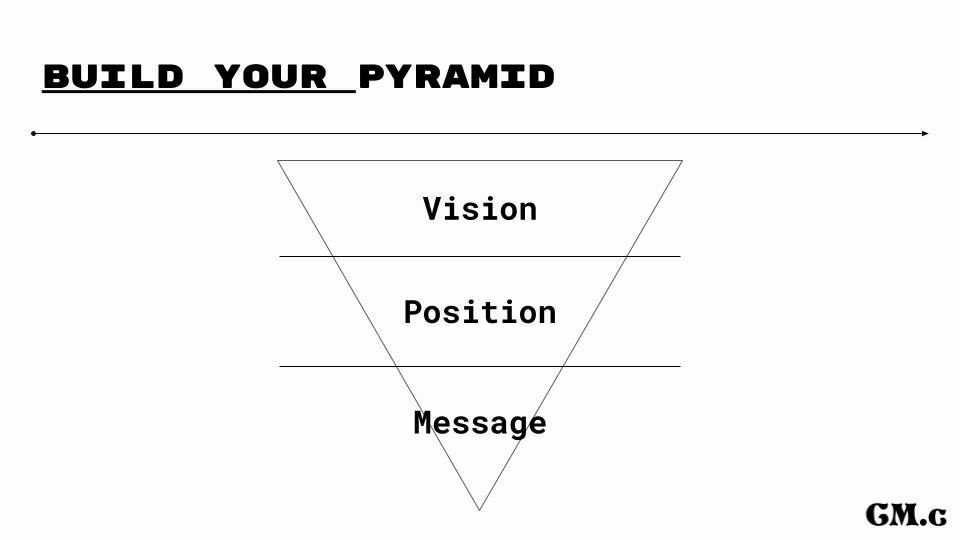
You need a clear vision—a clear point of view—on the problem you’re solving, in addition to solving it in a differentiated and better way.
This vision comes from the founder or CEO and sets the stage for the brand story.
Sometimes companies are product-led, in those cases story can act as an accelerant and differentiator. A compelling story isn’t required from the jump (or at least the seed of one), but it certainly helps.
To be a successful company, you have to have a point of view around a real problem you’re solving and how it truly helps the people you’re trying to help and serve.
Less “we make shirts,” more “passionate fishers spend a lot of time in the sun, we make shirts to keep them burn-free so they can spend less time worrying about reapplying and more time focused on reeling in that next great story.”
Don’t worry, this doesn’t need to be the fully realized, end game vision. You don’t have to have it all mapped out. But you need to be clear about where you are now and have a plan for what the next steps will be. And the vision can evolve as the product iterates and grows over time.
Positioning builds off this clear vision by applying it to a clear, well-defined category.
So you’ll need to start by determining if you fall into an existing category or are creating a new one. Then you’ll need to know how you’re differentiating from what’s existing in the market / mind of the consumer. This step might be handled by a group at the company with roles similar to CEO, head of product, and head of marketing.
Messaging is how you communicate all this to your customers.
Turning the position you created into words that will resonate with your target market. And this is all in the hands of marketing. The more you get down to functional messaging the more the product people will likely take over, but keeping the brand peeps involved and in an ownership position can ensure cohesion.
The pyramid is upside down for a reason. Everything flows down from the vision, it is the base of the pyramid as far as foundational importance but top of the list as far as priority. Message is the tip because the entire thing balances and pivots on the strength of the messaging.
The Quick Version
- Foster a sense of both belonging and individualism.
- (Truly) Differentiate the product.
- Position and market against the status quo.
- Develop routine and ritual built on charisma and connection.
- Don’t drop the ball.
👹 News Headlines & Animal Spirits
We may be heading towards a recession (we technically always are, it’s just a matter of time frame), but we don’t require one to come down from inflation.
A primary factor in recessions is consumer confidence.
Continued headlines acknowledging a looming recession can cause a recession by eroding that confidence.
Again, recessions are normal.
Businesses have cycles.
The economy has cycles.
Trends and fashion have cycles.
There are seasons for everything.
Everything about time is cyclical except for the narrative we tell ourselves about it being linear.
The cult of continuous growth we expect to be the norm.
How much of the current downsizing and sales numbers are a result of over exuberance during good times?
Big tech hired like crazy.
Retailers of all stripes are talking about a glut of inventory. (Whereas car dealerships can’t get enough inventory.)
Poor planning requires an adjustment.
And I’ve been wondering for a while who will be left holding the bag?
Maybe we have the wrong “re” in mind.
Less recession, more readjustment?