

See what I mean?
We are the messaging team on TikTok. Our team’s mission is to facilitate meaningful user connections through TikTok’s messaging experience, which is still in its infancy.
Collaborative creation is now creation and distribution.
Social media is splintering into content created by the few and private sharing by the many.
Or, all social apps are becoming messaging apps.
As it works to better align the app with evolving user behaviors, Instagram’s rolling out a new option to share feed posts with Close Friends only, providing another way to facilitate more enclosed group engagement.
Buzzword bingo: social is becoming a dark forest
Apple suddenly remembered it had a podcast app and wants to pull a Spotify and YouTube Music by diversifying the (non-music) content you can listen to.
Apple Podcasts becomes the best way for listeners to access many forms of premium audio content — podcasts, news briefs, narrated articles, radio shows with full music, educational courses, guided meditations, sleep sounds, and much more — all in one place.
We’ve had the golden age of TV. Time for the golden age of audio.
In the world of email marketing, clicks are more valuable than opens. Especially now that many email providers have anti-tracking measures that spoof opens (either inflating or deflating your number depending on implementation).
Reporting on open rates is like reporting on impression totals for paid ads.
This thread gets a lot deeper on this topic.
Speaking of holiday shopping season, it’s not all about the Black Friday Cyber Monday (BFCM) madness.
According to the new Capterra “2023 Retail Holiday Preparations Survey,” Labor Day is displacing Black Friday and Cyber Monday as the top-performing holiday sales event [for small-to-mid-sized retailers].
Holiday shopping is starting earlier and earlier (thanks pandemic supply chain shenanigans!) and BFCM is getting more and more dominated by big budgets and frothy algorithm auctions.
Once the online checkout process starts, you want it to be as easy as possible for the shopper.
Shopify is trying to help merchants out with its new one-page checkout.
If you can’t enable it yet, you should be able to within the next week or two. Perfect timing to iron things out before the holiday season kicks off.
The era of subsidizing subscriber numbers in a free money, growth-before-everything-else market is over. Streaming TV is is now cable and it will be ad-supported (but you can pay your way out of ads).
Amazon aims to show ‘meaningfully fewer ads’ than traditional TV or rival streaming platforms. An ad-free option will be available for an additional $2.99 per month.
TV has been fully unbundled. Which means it’s time to start bundling again.
I put Amazon, Apple, Google, and Roku at the front of the pack of potential bundlers due to saturation and having existing streaming hardware platforms.
5 Ways to Get More Customers
Looking to grow your business? Here are 5 to-do's you can use to increase your customer count, according to Hubspot's CMO.
Pick 1, do them all, your call.
Let's dive in.
Better Conversion Rates
Chances are your current conversion rates are somewhere south of 100% (and if they're not, stop reading this and enjoy your success), which means they can be improved.
This is the best place to start since the changes happen on a platform you own and control. Plus, it means more customers without more traffic and any increases in traffic should scale this up.
Some places to start:
- Make sure your phone number is on your site
- Use a consistent message throughout the conversion journey
- Provide (way) more value than anyone else
Follow Up Faster
The best way to turn someone who is interested into a customer is to not let them lose interest.
This is what social users expect:
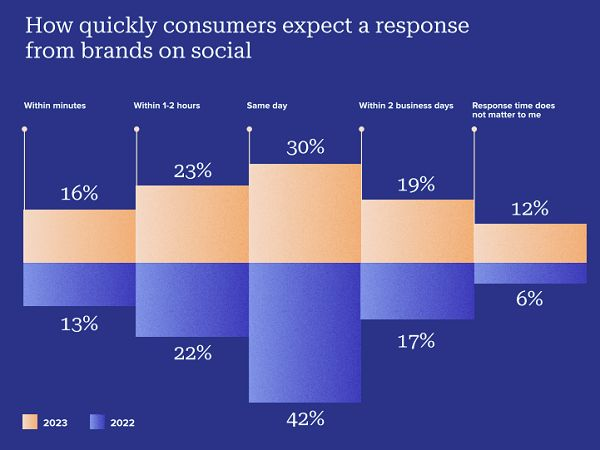
How can you respond faster?
- Automation (whether via autoresponders or AI)
- Better internal processes to incentivize more rapid responses
Customer Referral Program
Word-of-mouth always wins.
Turn your biggest fans into your best marketing and reward them for doing so.
(Assumes you've made something worth talking about in the first place, of course.)
Improve Net Promoter Score
What is net promoter score? It's that quick survey you've probably seen about how likely you are to tell a friend on a scale of 1-10. SaaS companies in particular love this metric.
I think it's a bit overhyped, but if it makes sense it can be useful data to have. Bonus points if you don't let people answer with 7, that's the cop-out answer on a 1-10 scale.
Beyond the specific tool used to collect/implement, listening to customer feedback is usually a good idea.
That doesn't mean you have to do everything they say, the customer is not always. But listening to what your customers say and how they say it can unlock insights to improve your experience, and create more customers.
All The Traffic!
You knew this one was coming. At some point, if you're still looking for growth, the only way is to get in front of more people.
But that doesn't mean you just start flooding every platform du jour with your brand.
Obsess about 1-2 core channels
Organic search and paid advertising are the classics. The first is for long term dividends, the second is for reach and sale.
If you have the capabilities, something like YouTube or a podcast could be a good channel for you. Content can create a moat via parasocial relationships. Similar to cultivating a community. These efforts are hard for other brands to duplicate and can create deeper relationships with your core fans. This also means these efforts are harder to make and maintain.
Don’t spread yourself too thin
Max out one or two channels that drive traffic and performance. Don't get distracted by new and shiny things or that one quick hack you saw in a headline, focus on your top channels and make sure they're finely tuned.
Once you've maxed those out you can think about other channels. Just make sure the new channels don't come at the expense of your top channels.
TL;DR:
5 ways you can get more customers (chances are there is at least 1 item on this list you aren't doing):
- Improve your conversion rates
- Respond faster
- Start a customer referral program
- Improve your net promoter score (/listen to customer feedback)
- Get more traffic
More ads in more places, Microsoft is rolling out Conversational Ads in Chat.
First up:
Compare & Decide Ads pull all the relevant data of various car models into a succinct table so the user can easily evaluate different options based on the criteria they find most important.
Sounds like Wirecutter et al but as an ad placement directly in the search/chat results.
Interesting note from the announcement:
Our demographics data shows that Chat usage skews to young adults across all verticals