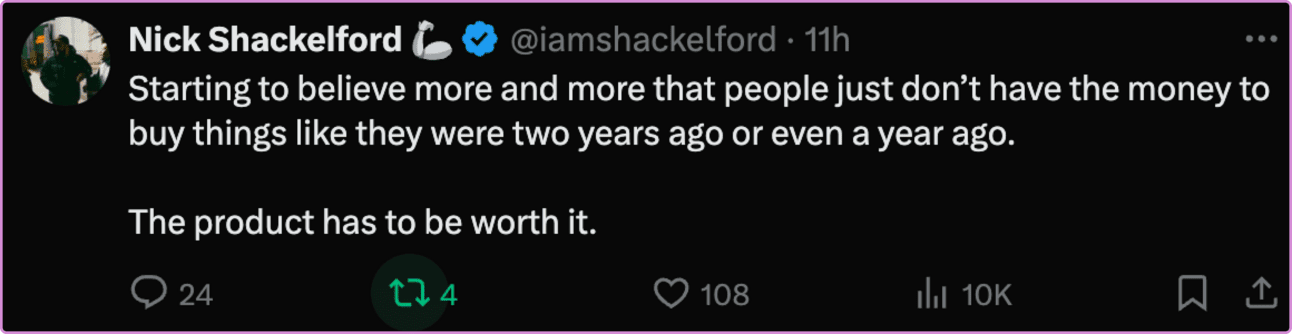
via the Future Forecast podcast:
Nowstalgia: hyperfast way of looking at nostalgia of things that didn’t happen decades ago but years or even months.
The nostalgia cycle is spinning so fast that the look back period is shortening to hypermodern history.
Or; the half life of attention (but not attention spans) is so short that the idea generation period has to compress to a point where sequels and building off the previous effort is the only viable option. It is impossible to both stay relevant and create from a blank slate each time.
Attention Spans or Filter Quality?
Are our attention spans really getting shorter?
I hear this said a lot.
But I also know people who listen to multi-hour podcasts, read books, binge series, run/bike really long distances, write books, build apps…
Yes, some of those aren’t really the things people are talking about when they say we’re basically goldfish with thumbs. But they’re not irrelevant.
Maybe the explosion of content and choices coupled with the rapid increase in quality and professionalization of many content creators mean our bar for “bad content” is really low.
Maybe instead of having shorter attention spans we have stricter quality filters.
Wednesday Bits & Bytes | 032724
Ad Market Expands 10.4% In February

The U.S. ad market expanded at its greatest rate in nearly two years in February – increasing 10.4% over February 2023
…
February also was the 11th consecutive month to post growth, providing a further indication that the U.S. ad economy is well out of recession.
This should mean good news for the economy as a whole too.
It also explains those CPM and CPC increases I’ve been noticing.
YouTube Warns Channels Against Deleting Videos
YouTubers: Don't delete videos unless you have a very, very good reason. When you delete a video, you delete your channel's connection to the audience that watched that video. If you want to maximize your growth, keep your videos public or unlist then if you must.
— Todd B. (@hitsman) March 23, 2024
Well that’s an interesting tidbit. & is this a “normal” algorithm thing? Or; does it map across platforms?
How consumers find new brands and products on social media, marketplaces, and brick-and-mortar retail in 5 charts
Instead of putting all 5 charts here, just click the link.
Tuesday Bits & Bytes | 032624
Exploding Topics: Anti-Detect Browser

Anti-detect browsers are web browsers designed to minimize the digital footprint of their users.
These browsers use a combination of techniques (changing user agent strings, modifying the browser’s fingerprint, using a VPN, etc.) to hide or modify a user’s device and browser characteristics.
They may also block or modify JavaScript, cookies, and browser plugins that can be used to track a user’s online behavior.
…
9 out of 10 Americans consider online privacy an important issue.searches for “data privacy tools” have grown by 67% over the past two years.
The cookiepocalypse was just the start.
Spotify adds video learning courses in latest experiment
“One of the most interesting things and trends that we started noticing was more and more people were starting to come to Spotify with some intent of learning,” Jitani says. “And we thought, how can we take this core insight and build something on top of it?”
it can more directly target potential customers based on their existing listening habits. “It becomes much, much easier for us to find the right people for this course and just provide a much more efficient kind of distribution,” Jitani says.
With the experiment, Spotify is offering courses via a freemium model, similar to the one it used when it first launched audiobooks.
Many lessons wrapped up in this:
- Spotify is serious, which means now is the time to start experimenting with its ad platform (if you haven’t already)
- Distribution matters
- Context is the new targeting paradigm
- Everything is a video platform now
- Entertainment isn’t the only content angle out there, people want to learn (otherwise, why else are you reading this right now?)
LinkedIn introduces Dynamic UTMs to optimize your web traffic through LinkedIn ads
Marketers – only one time per campaign – will add a dynamic UTM parameter to their campaign and then we’ll automatically pull in the account, campaign and/or creative name into the destination URL so it can be picked up by analytics tools, allowing marketers to more easily analyze results.
And there was much rejoicing!
Eddie Bauer changed its logo because Gen Z doesn’t read cursive
After nearly 60 years of its distinctive cursive script, the outdoor retailer is ditching the script for blocky text and a goose.
I’m torn on this one because I saw the old EB logo a lot growing up, but the new one should work way better for a lot of materials and uses. But it’s also just another chunky sans serif wordmark now.
As we start to lose more and more of the old brand aesthetics, we may also lose a lot of character (which also means there is a growing void you can launch yourself into if you’re willing to zig when others zag).
Canva acquires Affinity to fill the Adobe-sized holes in its design suite
Web-based design platform Canva has acquired the Affinity creative software suite, positioning itself as a challenger to Adobe’s grip over the digital design industry. Canva announced the deal on Tuesday, which gives the company ownership over Affinity Designer, Photo, and Publisher — three popular creative applications for Windows, Mac, and iPad that provide similar features to Adobe’s Illustrator, Photoshop, and InDesign software, respectively.
Between this and the Figma deal getting blocked, Adobe better get its game face on.
Creative is the biggest lever you have left for targeting. Canva makes it easy. This deal may make it more legit with the design crowd.