

How to write good marketing messaging:
Write marketing copy, newsletters, emails, and messages as if to a sister, a best friend, or your mom/dad. And not for a state of the union or to a supreme court judge.
Act like you have a personality and the message was written by and for a human.
(That link also has a nice bit on identifying market gaps.)
What Can We Learn From Socks?


I love this question (paraphrased from the link above):
Is it a good use of marketing to come up with good ways to sell socks or shirts or notebooks or shoes or is that not the best use of people's time? Is there a modern equivalent for past marketing strategies that engendered a sense of belonging?
For 3 reasons:
- It gets deep
- It focuses on serving the customer
- I'm a Seth stan
I love the direction of the answer as well:
12 year old girls don't have a sock problem, they have a belonging problem. They have a culture problem. A problem of status and affiliation.
"Wanna see my socks," is a reasonably inexpensive way for a girl to indulge her desire to be part of something—maybe to one up a friend, have a conversation about fashion—for not a lot of money.
Lots of things in marketing exist not to do what it looks like they do, but to solve our emotional problems.
Not all of us are going to change the world or save lives. The rest of us might just be able to put a smile on someone's face. Produce something with a reduced set of side effects, that has effects that we can point to and say 'I made that.'
Marketing has its place. Not when it manipulates people or hustles them or hypes something. It has its place when it brings tension to the table in service of better.
Are you selling socks or are you selling solutions? (And no, this isn't just about socks.)
From Social Media Today: 3 Important Social Media Trends of Note for 2023
Hot = LinkedIn
Not = X (Twitter)
Still Hot = Instagram
Quick refresher on some brand settings in Google Ads.
If you want to use broad match keywords but also want them to be brand relevant, try brand restrictions:
For Search, brand restrictions limit traffic to serve only on search queries related to specified brands.
If you don’t want to use Performance Max for branded queries but more strictly for prospecting, try brand exclusions:
For Performance Max, brand exclusions provide added control so your campaigns won’t serve for branded queries you want to avoid on Search and Shopping inventory.
It's A Metric! Hook Rate
Are your videos thumb stopping?
Do they have the right hooks?
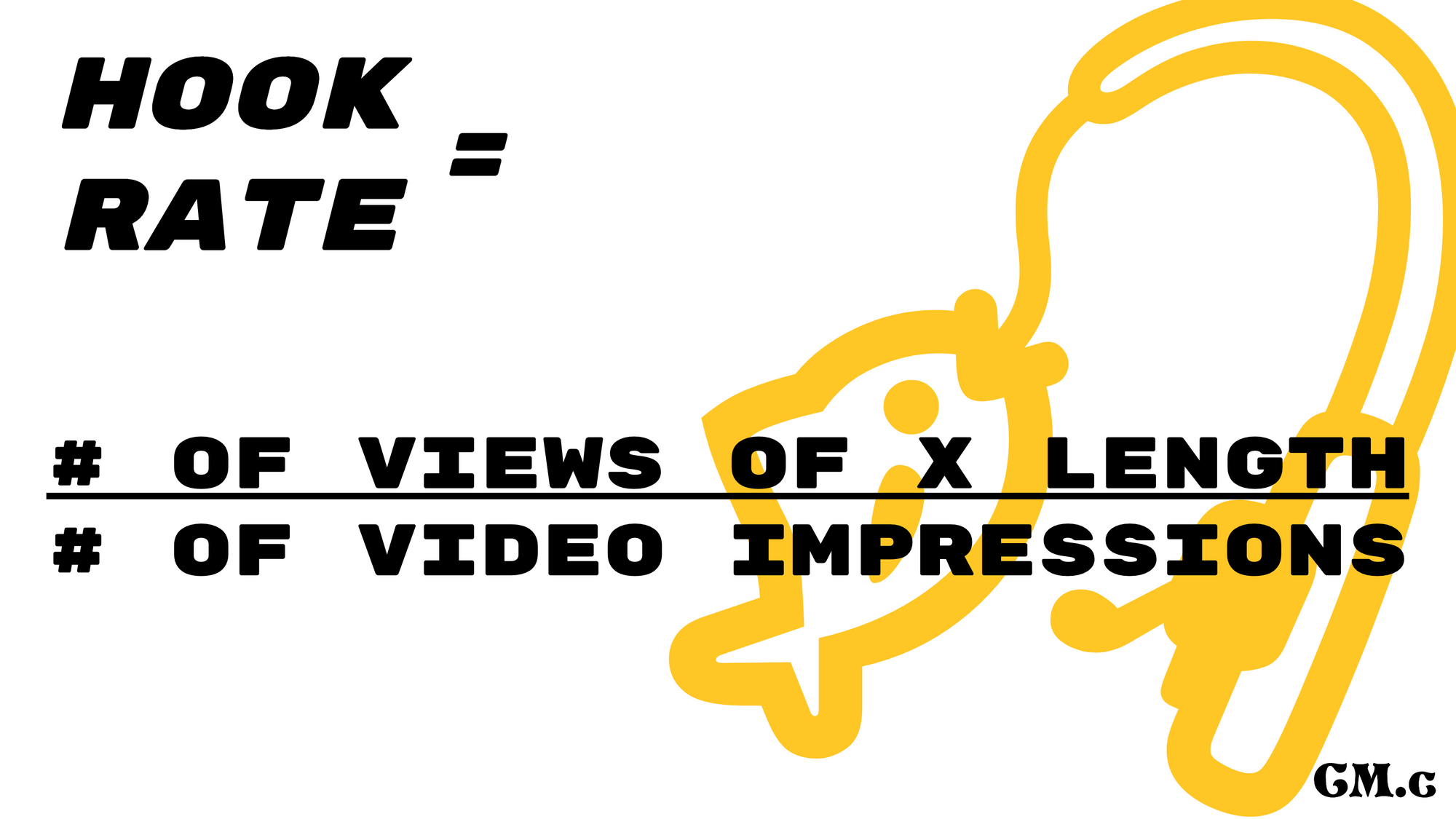
To find out, calculate the hook rate.
Solve for X
How do you pick a video length?
The easiest answer is that you go with what each platform gives you.
The current standard set by the Interactive Advertising Bureau is 2 seconds (I think this used to be 3 seconds), which makes it a common metric across platforms.
Meta reports on 2 second views (or at least has columns for it), 3 seconds, and ThruPlays—which are views up to 15 seconds (either entire video or 15 seconds if longer). You can optimize for 2 second views or 15 second thruplays.
TikTok reports on 2 second views and 6 second focused views. You optimize for focused views.
Pinterest reports on 2 second and 3 second video views. Bidding based on 2 second views.
LinkedIn reports on 2 second views. Or a click. Whichever comes first.
Google / YouTube counts a view as a duration up to 30 seconds depending on the length of the video. Anything shorter than 30 seconds counts a full play as a view. Clicking the video ad also counts as a view. And viewability is based on 1-2 second views depending on type. Honestly, a bit messy.
I do wish 5 second views was an easy-to-pull metric as this is the cutoff frequently cited by these platforms. Most best practices talk about what you need to include in the first 5 seconds. But they didn't ask me what should be in the reporting view, so oh well.
What's Good?
Every decision maker's favorite question and every analyst's least favorite.
The short answer: it depends!
The best approach would be to develop an internal baseline and then start keeping an eye out for outliers, good and bad.
But let’s say ~25%. Because that’s a nice round number that falls in line with this benchmark analysis.
Get Hooked Up
As with most metrics, hook rate is useless in a vacuum.
Here are a few use cases I can think of to incorporate hook rate into your strategic analytics toolbox:
- Compare hook rates across platforms to identify high performers and those that may need different creative to succeed.
- Compare videos within a platform to see what hooks viewers the most and adjust your (platform-specific) creative strategy accordingly.
- Monitor hook rate for each video over time to determine when effectiveness is waning and creative fatigue may be setting in.
- Determine if there is a correlation between hook rate and business goal performance.
- For A/B testing, of course.
To Review
Hook rate is the number of video views of a certain length divided by the number of impressions that video delivered.
As an example, a client's Meta account has a video with 6,902 3-second views so far this month on 15,970 impressions.
6,902 / 15,970 = 43% hook rate
Go forth and measure!
Syllabus:
- Benchmarking Facebook Video Ad Hook Rates
- What is a Hook Rate? (I find the written explanation of the formula sub-par in this, but it includes more platforms and context if you’re interested.)
- Google: Overview of Viewability and Active View