


Shorter copy drives more action. It’s science!
3 ways to shrink your copy:
- Fewer words
- Fewer ideas (be really clear on your goal)
- Fewer requests: more requests = less action on any of them
Be clear
Be concise
via the Nudge podcast
Everything is marketing.
Unless what you’re doing is unique, it’s really marketing at the end of the day.
&
Brands are becoming media companies. So we’ll see more Red Bulls of the world.
& media companies are becoming brands.
We’re just going to see this amalgamation of everything being everything
via the Future Forecast podcast
Is attention the new attribution?
The New York Times is partnering with Adelaide, a company that uses signals like eye-tracking data to gauge whether readers are paying attention to ads.
The Times started using its own proprietary attention metric last year
The goal is to eventually tie attention metrics to advertisers’ campaign performance
Attribution is getting increasingly difficult. So is garnering attention.
As the value of attention increases it could function as a proxy metric for ROI and related metrics of attribution.
What is the return on attention?
via Marketing Brew
Ferret-UI offers the possibility of advanced control over a device like an iPhone. By understanding user interface elements, it offers the possibility of Siri performing actions for users in apps, by selecting graphical elements within the app on its own.
There are also useful applications for the visually impaired. Such an LLM could be more capable of explaining what is on screen in detail, and potentially carry out actions for the user without them needing to do anything else but ask for it to happen.
via Apple Insider
🔥 insight from Tom Webster:
years ago, in the late 20th century, where I am from, there was a thing called videotape, and there were two different standards of videotape and they fought constantly. There was Betamax, which was a platform put out by Sony that was not an open platform. It was a closed platform. Then there was VHS. VHS was developed, I’m pretty sure, by JVC, but they brought in lots of other partners, brands that we all know and love, like Quasar, right? Does anybody remember who won that battle?
VHS? No. Nobody won that battle because we don’t watch tape anymore. We watch movies.
Why do I like this story?
It highlights a few things I think are important to remember:
- you’re not just competing with your industry competitors (especially with inflation and housing where it’s at right now)
- consumers are shopping for solutions and categories, not your specific offering (until they become fans, then they’re shopping for you)
- & you can go further with friends
Indicator Bingo March 2024
Inflation is up
The Consumer Price Index for All Urban Consumers (CPI-U) increased 0.4 percent in March on a seasonally adjusted basis, the same increase as in February
via BLS
Earnings almost kept pace
Real average hourly earnings for all employees were unchanged from February to March, seasonally adjusted… This result stems from an increase of 0.3 percent in average hourly earnings combined with an increase of 0.4 percent in the Consumer Price Index
via BLS
An economic research group is
forecasting another 5% surge in home prices this year.
via Business Insider
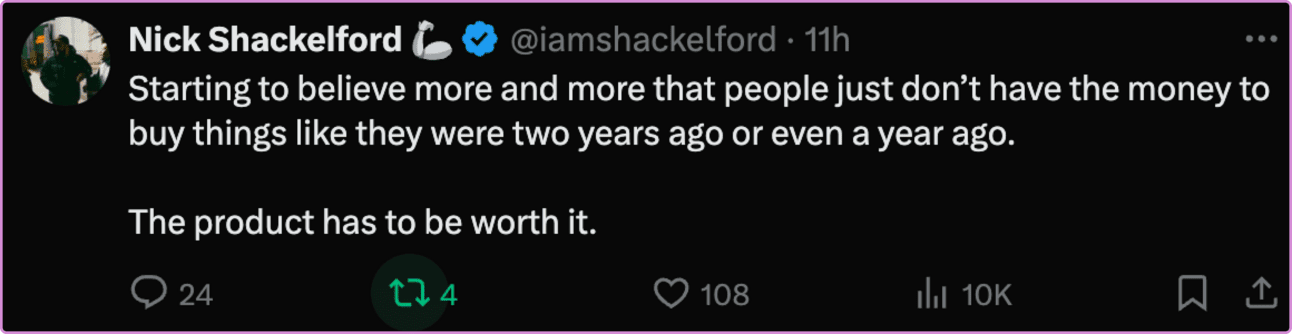
Consumers feel like their money doesn’t stretch as far and their dreams are getting more expensive.
Or, as this tweet featured in DTC Daily puts it:

Ulta Beauty's Retail Media Move
A recent episode of eMarketer’s Behind the Numbers podcast focused on retail media and this tidbit jumped out:
Yeah, I am super excited for Ulta Beauty’s Smart Vending Machines. They are piloting them currently in 10 cities across the U.S and essentially all people have to do, if you’re a rewards member, you just put in your phone or your email. If you’re not a rewards member, you can join right at the machine and you can claim a free travel size beauty product every week, which I think is really interesting.
So that’s a great incentive to keep coming back to get new things. They’re constantly refreshing the assortment, and again, you get a little travel size and you like it, you’re going to buy the full size. So it really is just its own little ecosystem which keeps people coming in, trying products. And for Ulta, it’s driving rewards member signups, and you’re getting additional customer info on their preferences and how often they’re coming in-store. So it’s really a win-win all around.
This is smart.
It’s a defensible moat. It’s not cheap to roll something like this out, which means all their competitors won’t have their own version live next week.
It’s unique. Any competitor that tries it now will be seen as a copycat. (I don’t know much about beauty, but if being “on trend” is part of the draw for customers, they’ll likely want to shop with the trendsetter and not the trend follower.)
It’s a retail media opportunity. There are a finite number of slots. If it takes off and they can prove the conversion from try to buy, companies will pay to put their product samples in the vending machine. It could even get to the point where certain spots command higher rates due to increased selection frequency from their position in the browsers eye line. (a.k.a. the grocery store model.)
It’s shareable. This is an experience people will talk about. I can see people posting videos of their trip and reviews of their trial products. To increase its potential as UGC machine, (and again, not a beauty expert) I would add a random/surprise slot and/or random double rewards giving loyalty members 2 free products. My thinking here is similar to the Pret A Manger loyalty program and slot machine psychology. (And my love for the mystery Airhead experience.)
It’s sticky loyalty. Any business with a high returning customer rate has pivoted from growth to retention in the post-free money era. A new free product each week gives people incentive to return and each return increases the likelihood of a purchase. Lock in likelihood also increases as loyalty members have more chances to become brand and product loyal.
All that to say, I like this idea. Well done, Ulta.
Now Liquid IV or LMNT needs to a do a smart gumball machine in gyms and retailers dishing out random flavors.