

How To GA4: Session Source / Medium
Previously included in the Hacking GA4 post about search bar filtering, this bit now has its own video so it's getting a post too.
 Kyle Mensing
How To Find Source / Medium Data in GA4
GA4 features two levels of data aggregation: User & Session.
When it comes to acquisition metrics, user is the first-touch data. This will be imperfect due to cross-device usage, ad blockers, privacy considerations, yada yada, so on, & etc. But the first user [level of detail] metrics tell you how users got to your site the first time.
Session level is what you're used to from UA. What channel does each session originate from. This is where you'll spend most of your time analyzing ad performance.
And, if you're like me, you'll want to know which campaigns, ad groups/sets, and ads are driving what type on traffic and engagement. Which means looking at source / medium and other UTM-parameter based data.
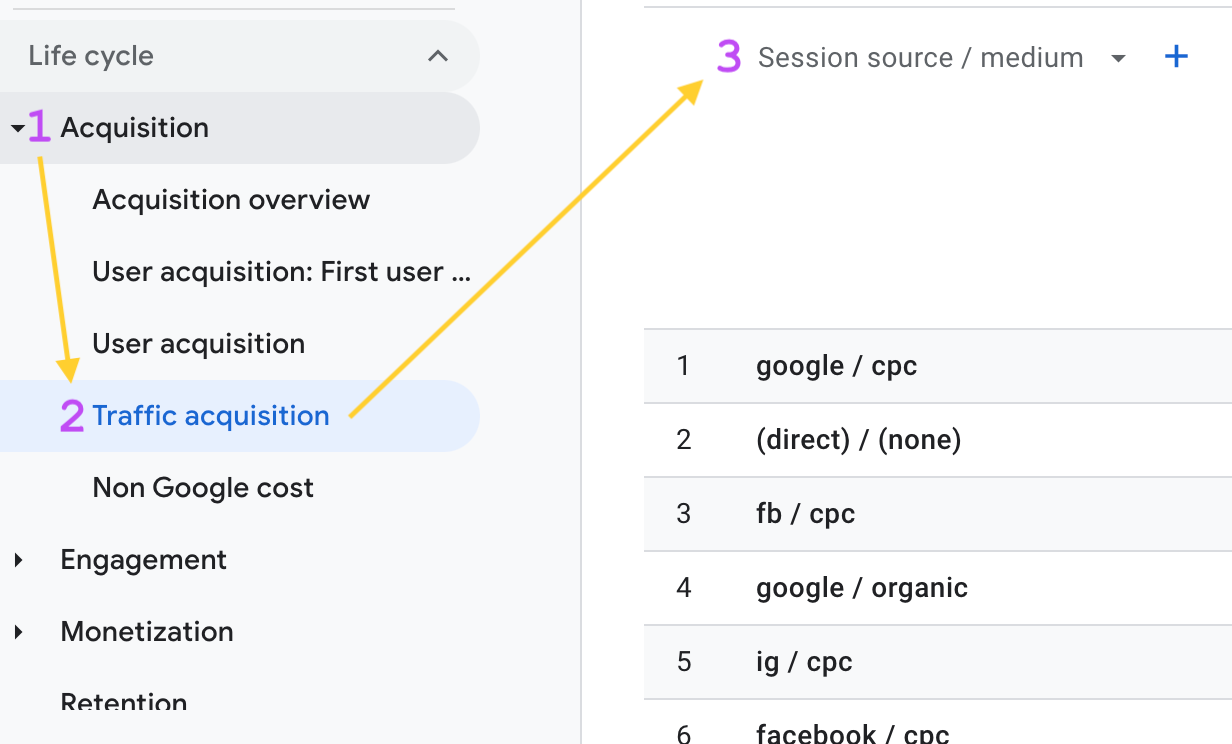
Here's how you find it in the default acquisition report (I recommend building Explorations for anything you'll want to dive into on a regular basis):
🚨🚨🚨
As reported on the linkblog:
Starting on (roughly) November 30, some UTM data has stopped populating in GA4.
I can’t see anything more granular than campaign level data from my UTM tags. A friend reports the same issue.
It appears the Google team is working on a fix.
UPDATE: Starting on 12/6 or so we began to see this data populating again. There was rumor of Google trying to restore the missing data but I still don't see any for the "dark period."
Want to know which traffic sources and mediums are driving what kind of metrics and engagement in GA4 but not sure where to look? You need the session source / medium breakdown in the traffic acquisition report.
Let’s dive in 👇
Instagram is considering a new feature called “flipside” that allows users to establish a new, private side to their profile where they can post more candid and personal photos for a subset of their friends. The feature essentially productizes “finstas” — the slang term for alternate Instagram accounts where people post their real-life photos, as opposed to the more polished photos they post on their public Instagrams.
All social media is now groups.
_via TechCrunch
🍪 Cookie Crumbs
In light of this (from the linkblog):
- Protected Audiences (formerly FLEDGE & who knows how many other acronyms)
- Enhanced conversions
- Consent Mode (not new, but more important)
The cookie is about to actually crumble
Let's revisit this old Kyle's Corner from a Blue Ion newsletter:
Cookie Monster
Is the modern era of internet advertising coming to an end? There are plenty of think pieces that will try to convince you of that. iOS 14.5 dismantled tracking users across services, and when Google phases out third-party cookies in Chrome in the not-too-distant-future, it’ll join most other major browsers to have done so.
Let’s recap, shall we?
- In iOS, users must now opt-in to allow apps to track them and Facebook advertising is taking a hit
- Android will go halfway later this month with the safety section of the Google Play store (more transparency, less opt-in/out)
- Soon, most major browsers will have similar measures in place
- iOS 15 introduced email tracking opt-out, which means no IP data for location and incorrect open rates (think 100%)
What comes next? [Insert shrug emoji here.] If Google has its way, maybe we’ll FLEDGE and Topics. Perhaps Apple launches an ad platform and we start paying a different tech giant. Or contextual advertising comes back in a big way (the seller side looks to be pushing this angle). A common feature of many prominent alternatives is to collect and maintain user data on a user’s device or in their browser and share an anonymized signal with ad platforms that acts like a yes/no button for whether or not the user is in the targeted audience.
In the meantime, the safe approach looks to be leveraging data you own (CRM (We can help) or email list) or the platforms own (interests and engagement actions happening within their walled gardens).
At this point, there is more uncertainty than clarity. But the safest bet is the same as it’s always been: own the customer relationship and build your own database (it does not have to be a literal database).
Buckle up, it’s going to be a bumpy ride.
And now you don’t even have to take my word for it, you can take McKinsey’s! The 3 consultant-certified recommendations?
- Collect first-party data (the stuff users voluntarily share with you)
- Create partnerships to leverage second-party data (your partner’s first-party data)
- Run contextual ads (the ads match the content of the page the user is on; or, the way internet advertising used to run.
Protected Audiences
Say what now?
The Protected Audience API proposes new privacy-preserving ways to power remarketing and custom audience solutions so advertisers can re-engage with site visitors.
With the Protected Audience API, a user’s browser stores advertiser-defined interest groups that it is associated with and hosts on-device auctions to show ads. Similar to how interest groups work today, the Protected Audience API will help marketers do things like showcase different product categories, appeal to visitors who didn’t convert, and re-engage visitors who abandoned shopping carts. Unlike today, however, user information won’t be collected and shared to many companies by third-party cookies.
I think it's basically social media style interest targeting for the broader web.
Visit Carmax.com, get placed in the automotive interest group, get delivered car-related ads.
The interesting piece is the browser-side handling. Browsers could be way more robust and interesting than they are now. They're basically the OS for the internet and (probably) the most used tool on many people's computers.
I expect more and more things to be handled via browser-side or on-device mechanisms moving forward.
Startups are ideas searching for a business model.
Or, as the curious marketer might say, stories in search of their audience.
Of course with startups it gets weird because the first audience is investors and the second is customers. What both those audiences want and need are very different. But starting with audience 1 changes the way you approach audience 2.
It not just about finding AN audience, it’s about finding THE audience.
The one that wants to tell the same story—that wants to co-create a story. With you.
- Protected Audiences (formerly FLEDGE & who knows how many other acronyms)
- Enhanced conversions
- Consent Mode (not new, but more important)
The cookie is about to actually crumble
Nuggets from Mickie Kennedy
One of the most important things that small businesses ignore is their own story. What they do that’s unique and different from everybody else. And how they came up with that as a business model.
&
You want to ask meaningful questions that are very timely and specific to right now.
& from (host) Travis Albritton
Your marketing can’t just be about you and your own selfish interest if you want it to resonate with people that you want to interact with your business in a positive way.
Not many surprising predictions in this piece, but I’ve been waiting for this:
The fastest-growing media channel in 2024, according to Forrester, will be in-game advertising. Almost half of online US adults who use smartphones said they regularly play games on their phones, and although “gaming remains a laggard medium for advertisers,” media giants like Microsoft and Sony are leaning in, which could help convince some advertisers to follow suit
Could be a way for Microsoft to carve out a unique niche with advertisers.
Will 2024 be in-game’s QR moment?
This would be a welcome Christmas present:
prices fell 2.6% [this past October] from a year earlier, marking the fifth straight month prices for durable goods experienced deflation
Morgan Stanley economists expect the deflation trend to continue through at least the midway point of next year due in part to strengthened supply chains, a projection that jives with stabilization tracked by the New York Fed’s Global Supply Chain Pressure Index.
In fact, deflation may remain so strong, it unwinds much of overall inflation all on its own
I’ve been posting (and thinking) a lot about audiences lately (and how to talk with them)
So this Seth Godin post struck my fancy. There are many ways to group an audience, and none of them result in a perfect crossmatch of interests, aspirations, and needs across its population.
And always remember:
We are all weird, and that’s okay.