

Welcome to dead week planning week!
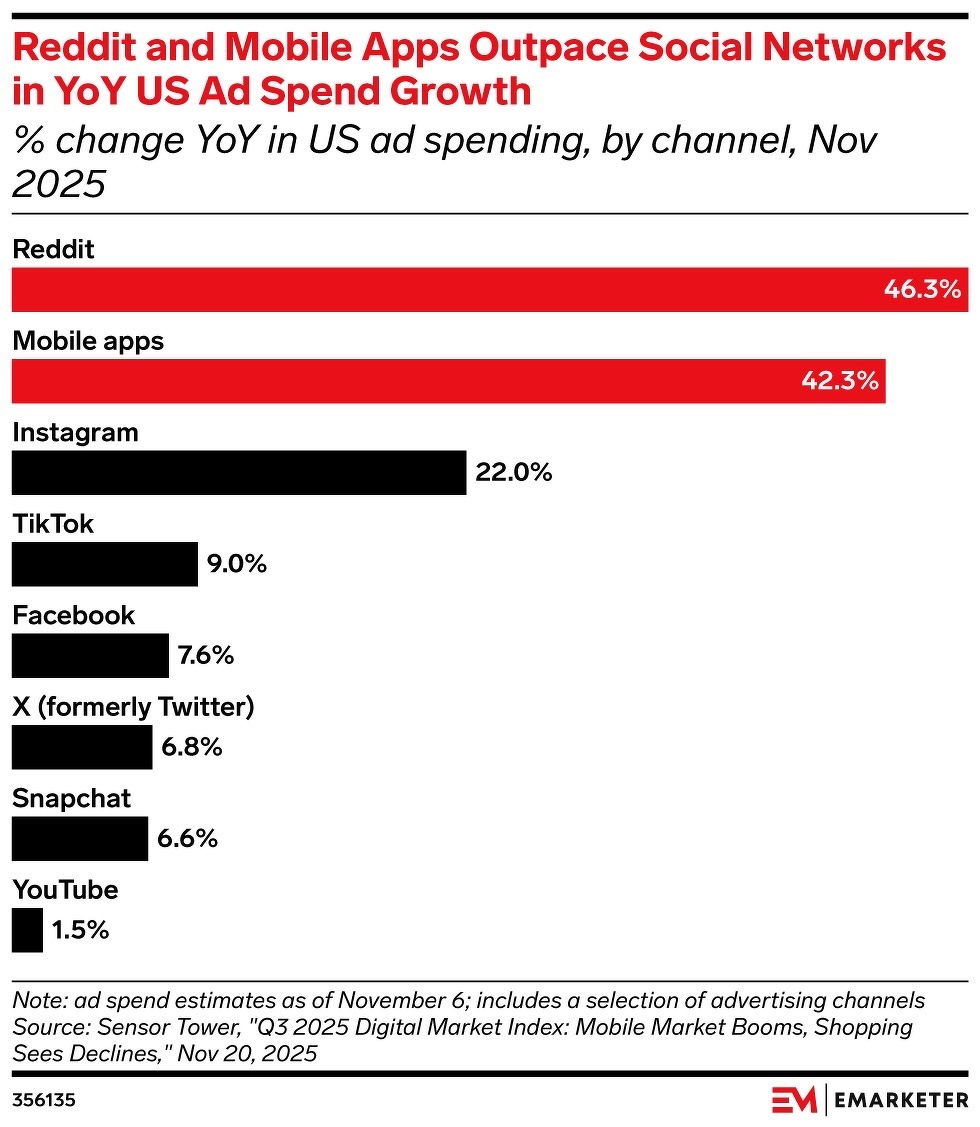
Reddit and mobile apps (Applovin’) are hot like Hansel with advertisers right now. There’s probably plenty of runway left for ad growth (unlike Meta), but the question remains:
Should you zig or should you zag?
via EMARKETER
Your logo is not your brand.
Making the rounds on work chat today, from Seth Godin’s archive:
Spend 10,000 times as much time and money on your brand as you spend on your logo.
Your logo is a referent, a symbol, a reminder of your brand.
But your brand is a story, a set of emotions and expectations and a stand-in for how we think and feel about what you do.
Building a brand is expensive today and cheap tomorrow.
I find this to be a very helpful way to think about AI
Venkatesh Rao proposes that Artificial Intelligence is actually Artificial Time, that it compresses decades, centuries of learning in hours and minutes and makes it available to us as augmentation
I have long taken issue with the “intelligence” part of the term “AI”. It pre-loads our thinking with ego since humans have a hard time conceiving of any type of intelligence that isn’t human intelligence.
What interesting things might we miss because the system isn’t imitating a human?
Don’t replace. Accelerate.
via Sentiers
Hire an indie agency in 2026
Indie agencies — more nimble, experimental and closer to challenger brands — are often the ones ushering clients into audio first.
Maybe this one?
via The Current
Through conversations with clients and watching the economic indicators, it’s clear the theme of 2025 was uncertainty.
More than half of Fourth District business contacts said that “uncertainty and the potential impact on demand” was the most important factor influencing their capital expenditure plans for the rest of 2025
SOP seemed to be “wait and react.”
Would not be surprised if 2026 sees reactionary responses to the uncertainty of 2025.
Is Google Choosing The Middle Way?
Google pushed hard into AI-in-search, but has (reportedly) scaled that back a bit. This is after the zero click revolution, of course.
Now it seems like maybe Big G is figuring out there is a middle ground where humans like to be. Clicking and exploring, but not having to do all the filtering work themselves (especially in a post-SEO hellscape).
Google recently rolled out “read more” links in Google search results, which appear at the end of the snippet’s description. When you click on the read more link, you are anchored down to a specific portion of the web page that you clicked on.
Or maybe this is just wishful thinking.
Discovery is no longer a search engine activity. And for many users, social is becoming the internet (AOL 2.0?).
When asked which were their main sources of website traffic, SMBs named social media (64%) more often than even SEO (52%).
In fact, 35% of small businesses operating without a website said that the traffic and leads they get from social (and other platforms like marketplaces) are the primary reason they don’t plan on launching one.
Beware building on rented land.
Technicality monster argument, everything is a search engine now so all content has SEO.
via Wordstream
Brilliant
Travelodge introduces free wrapping rooms in three of its UK hotels, giving parents a private space to wrap gifts and keep Christmas surprises intact.
via TrendWatching
2026 might let you run ads in Apple Maps.
This is a good time to get your Apple Maps listing in order either way.